



Feeding 9 Billion: Innovations in Agricultural Modeling
Drilling has been completed on the deepest borehole for seismic instruments in the eastern U.S. The four-inch diameter hole for the Central U.S. Seismic Observatory (CUSSO), located at Sassafras Ridge in Fulton County, Kentucky, reached a depth of 1,948 feet, where bedrock was encountered.
The location is near the most active part of the New Madrid Seismic Zone, the source of at least three major earthquakes in the winter of 1811-12, before the region was heavily populated and developed. This location will allow instruments in the seismic hole to gather the maximum amount of data from the region’s earthquakes for thorough evaluation of their effects on bedrock and soil and the resulting ground motions.
“Now that the well has been completed, our focus will be on getting instruments installed and collecting data vital to the region,” says Jim Cobb, director of the Kentucky Geological Survey (KGS) and state geologist
The partners in the project, including the University of Kentucky, KGS, and several federal agencies, will now determine the type and number of instruments to place in the shaft and at what depths to place them.
Five partners involved in the project committed nearly $300,000 to the drilling project. Much of the funding came from the U.S. Department of Energy through the Kentucky Research Consortium for Energy and Environment. The Department of Energy has an interest in the region’s earthquakes due to uranium enrichment operations at the Paducah Gaseous Diffusion Plant.
Edward W. Woolery of UK’s Department of Earth and Environmental Sciences and Zhenming Wang of KGS led the effort to plan and secure funding for the project. The next step in the process of completing the project will involve a workshop sponsored by the partners to gather input about the instruments to be placed in the observatory. The partners will apply to agencies such as the Department of Energy, the National Science Foundation, and other sources of funding for the purchase and installation of the instruments.
When instrumentation is completed, the observatory will be added to the Kentucky Seismic and Strong-motion Network, a series of monitoring stations operated by KGS and the Department of Earth and Environmental Sciences.
It will add new data on the origin, location, magnitude, and depth of earthquakes in this region to the information currently gathered by the network’s 26 instruments.
Data collected will help geologists and engineers better define the earthquake hazard in the region. Knowing the hazard has implications for economic development in the region as well as specific applications for ongoing activities at the Paducah Gaseous Diffusion Plant.




Earthquakes in the American state of Utah, the Soultz-sous-Forêts region of France or in the Dutch province of Groningen should not be able to occur even if the subsurface has been exploited for decades. This is because the shallow subsurface behaves in such a way that faults there become stronger as soon as they start moving. At least that is what geology textbooks teach us. And so, in theory, it should not be possible for earthquakes to occur. So why…
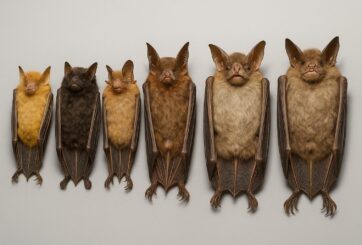
Just in time for Halloween, researchers from the Royal Ontario Museum (ROM), the Field Museum in Chicago, and Lawrence University in Wisconsin have announced the discovery of six new species of bats. These newly identified species, all found in the Philippines, belong to the group known as tube-nosed bats—a fascinating and diverse branch of the mammal family tree. Expanding the Tree of Life Formally recognized as new species through morphological and genetic analysis, this discovery expands the already impressive global…
In a recent study published today in the European Geosciences Union (EGU) journal Biogeosciences, scientists have confirmed that mercury pollution from artisanal and small-scale gold mining (ASGM) is contaminating food crops not through the soil, as previously believed, but directly from the air. Driven by the surging price of gold, which has increased by more than tenfold since 2000, the rapid expansion of unregulated mining in these regions raises urgent questions about food security, human health, and environmental justice The…
A new study from Iceland’s Surtsey island shows that birds carried most of the plants that colonised the island, challenging long-held beliefs that seed or fruit shape determines how plants spread — offering fresh insight into life’s adaptation to c When the volcanic island of Surtsey rose from the North Atlantic Ocean in 1963, it offered scientists a once-in-a-lifetime opportunity to observe how life takes hold on a brand-new and barren land. For decades, ecologists believed that plants’ ability to…
 Feedback
