



Feeding 9 Billion: Innovations in Agricultural Modeling
The remains of the apeman, dubbed Little Foot, were discovered in a cave complex at Sterkfontein by a local South African team in 1997. Its bones preserved in sediment layers, it is the most complete hominid fossil skeleton ever found.
Little Foot is of the genus Australopithecus, thought by some to be part of the ancestral line which led directly to man. But research by Dr Jo Walker and Dr Bob Cliff of the University of Leeds School of Earth and Environment, with Dr Alf Latham of Liverpool University's School of Archaeology, Classics and Egyptology, shows the remains are more than a million years younger than earlier estimates.
The team used uranium lead chronology to date the remains. Working on extracts of stalagmite deposits from immediately above and below the body, they dated the skeleton at around 2.2 million years old.
Their findings, published in the American journal Science, are controversial. Earlier estimates had put the age of Little Foot at three to four million years old placing it potentially on a direct line to humans.
The first recognisable stone tools appeared in Africa around 2.6 million years ago, but they were not made by Australopiths. Rather it is thought the first tool maker was Homo habilis, whose evolution is believed to have led directly to man. Rather than being older than Homo habilis – and a possible direct ancestor – Little Foot is more likely a distant cousin.
His remains are cemented in hard mineral deposits in the Sterkfontein cave complex which has yielded a number of other ancient finds. It is thought he either fell down a shaft or somehow got trapped in the cave and died there to be covered by the sediment layers from which he is now being slowly extracted. These sediments are themselves sandwiched between stalagmite layers which provided the materials for the dating process.
Australopithecus walked on two legs, but stood just 130cm tall and had a brain comparable in size with a modern chimpanzee. As Dr Walker explained: “In many of these finds, the smallest bones have disintegrated, but here the feet and hands are well preserved – and these could enable researchers to show how well adapted this early primate was to walking on two feet.”
But the sediment encasing Little Foot is harder than the bone – making extracting him a painstaking process for the South African team.
And Drs Latham and Cliff have now turned their own attention to further Australopith findings at Makapansgat, also in South Africa, where other specimens of Australopithecus have been found.




Earthquakes in the American state of Utah, the Soultz-sous-Forêts region of France or in the Dutch province of Groningen should not be able to occur even if the subsurface has been exploited for decades. This is because the shallow subsurface behaves in such a way that faults there become stronger as soon as they start moving. At least that is what geology textbooks teach us. And so, in theory, it should not be possible for earthquakes to occur. So why…
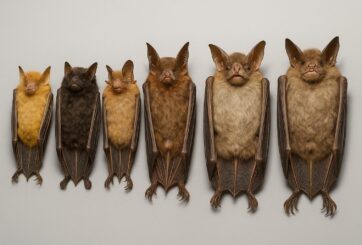
Just in time for Halloween, researchers from the Royal Ontario Museum (ROM), the Field Museum in Chicago, and Lawrence University in Wisconsin have announced the discovery of six new species of bats. These newly identified species, all found in the Philippines, belong to the group known as tube-nosed bats—a fascinating and diverse branch of the mammal family tree. Expanding the Tree of Life Formally recognized as new species through morphological and genetic analysis, this discovery expands the already impressive global…
In a recent study published today in the European Geosciences Union (EGU) journal Biogeosciences, scientists have confirmed that mercury pollution from artisanal and small-scale gold mining (ASGM) is contaminating food crops not through the soil, as previously believed, but directly from the air. Driven by the surging price of gold, which has increased by more than tenfold since 2000, the rapid expansion of unregulated mining in these regions raises urgent questions about food security, human health, and environmental justice The…
A new study from Iceland’s Surtsey island shows that birds carried most of the plants that colonised the island, challenging long-held beliefs that seed or fruit shape determines how plants spread — offering fresh insight into life’s adaptation to c When the volcanic island of Surtsey rose from the North Atlantic Ocean in 1963, it offered scientists a once-in-a-lifetime opportunity to observe how life takes hold on a brand-new and barren land. For decades, ecologists believed that plants’ ability to…
 Feedback
