



Feeding 9 Billion: Innovations in Agricultural Modeling
The new images can be accessed easily by clicking on the ‘Featured Content’ checkbox in the Google Earth sidebar and further clicking on the ESA icon.
People can take a journey around the globe, exploring detailed images of amazing landmarks and finding out about important changes to the environment. Helpful information, bubbles of facts and figures, scientific explanations and theories will appear underneath the images.
Google Earth Director John Hanke said: “We are inspired to see the European Space Agency using Google Earth to show such fascinating information about our planet through these striking images. This is another important step in helping people around the world to understand more about their environment.”
ESA’s Director of Earth Observation Programmes Dr. Volker Liebig said: “Integrating ESA images into Google Earth provides an excellent opportunity to create public awareness and interest for space technologies, and in particular for those related to Earth observation and the protection of the environment.”
“The imagery has been specifically chosen to afford Google Earth users the possibility to tour the planet from a bird’s eye view and to gain a different perspective and appreciation of their planet by witnessing its splendour as well as its vulnerable spots.”
The images in the collection are acquired by ESA’s Envisat – the largest environmental satellite ever built – ERS and Proba satellites. ESA’s Envisat, launched in 2002, acquires data using three imaging sensors: Advanced Synthetic Aperture Radar (ASAR), Medium Resolution Imaging Spectrometer (MERIS) and Advanced Along-Track Scanning Radiometer (AATSR).
The ASAR instrument uses radar to map the land, profile waves and ice, monitor land use and types of vegetation and measure some of the properties of the surface. MERIS acquires images of the planet’s surface and clouds in sunlight, capturing visible light and some of the infrared part of the spectrum. The AATSR sensor scans land and ocean surfaces to measure sea temperature, detect hot spots from forest fires and map the extent of vegetation in different regions.
Data from these sensors play a vital role in helping scientists, governments and others to understand the causes and consequences of global environmental changes – including detecting El Nino events, unravelling the mysteries of global warming, tracking global deforestation and pollution and gaining crucial insights into the rise in ocean levels.
‘Featured Content’ on Google Earth was launched in September and provides an opportunity for content providers like ESA to showcase content such as famous landmarks and scientific information.
Other providers on ‘Featured Content’ include:
United Nations Environmental Programme – The UNEP overlay for Google Earth includes successive time-stamped images illustrating 100 areas of extreme environmental degradation around the world. From the deforestation of the Amazon to the fallout of raging forest fires in Sub-Sahara Africa and the decline of the Aral Sea in Central Asia, this before-and-after imagery spanning the past 30 years offers users an online resource for learning about environmental crisis zones around the world.
Discovery Networks World Tour – The Discovery overlay enables travel enthusiasts and armchair tourists alike the opportunity to virtually visit major world attractions, cities, and natural wonders through Google Earth. Featuring streaming Discovery video segments, users can learn about the history and significance of various world landmarks, national parks, American and European cities, and African locations. These multimedia vignettes introduce users to the wonders of King Tut’s tomb in the Valley of Kings to the history of the gate of the Itsukushima Shrine in Japan.
Jane Goodall Institute – With the Jane Goodall Institute overlay users can visit Fifi and the other Gombe preserve chimpanzees and follow their daily exploits with the Institute’s 'geo-blog' in Google Earth. Updated daily, this geo-blog captures the work of the Jane Goodall Institute, illustrating the Institute’s research on chimpanzees and the effects of deforestation in Africa.




Earthquakes in the American state of Utah, the Soultz-sous-Forêts region of France or in the Dutch province of Groningen should not be able to occur even if the subsurface has been exploited for decades. This is because the shallow subsurface behaves in such a way that faults there become stronger as soon as they start moving. At least that is what geology textbooks teach us. And so, in theory, it should not be possible for earthquakes to occur. So why…
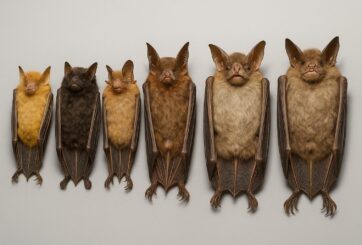
Just in time for Halloween, researchers from the Royal Ontario Museum (ROM), the Field Museum in Chicago, and Lawrence University in Wisconsin have announced the discovery of six new species of bats. These newly identified species, all found in the Philippines, belong to the group known as tube-nosed bats—a fascinating and diverse branch of the mammal family tree. Expanding the Tree of Life Formally recognized as new species through morphological and genetic analysis, this discovery expands the already impressive global…
In a recent study published today in the European Geosciences Union (EGU) journal Biogeosciences, scientists have confirmed that mercury pollution from artisanal and small-scale gold mining (ASGM) is contaminating food crops not through the soil, as previously believed, but directly from the air. Driven by the surging price of gold, which has increased by more than tenfold since 2000, the rapid expansion of unregulated mining in these regions raises urgent questions about food security, human health, and environmental justice The…
A new study from Iceland’s Surtsey island shows that birds carried most of the plants that colonised the island, challenging long-held beliefs that seed or fruit shape determines how plants spread — offering fresh insight into life’s adaptation to c When the volcanic island of Surtsey rose from the North Atlantic Ocean in 1963, it offered scientists a once-in-a-lifetime opportunity to observe how life takes hold on a brand-new and barren land. For decades, ecologists believed that plants’ ability to…
 Feedback
