



Feeding 9 Billion: Innovations in Agricultural Modeling
Almost all aspects of societal and economic activities in the Monsoon Asia region are critically dependent on the monsoon circulation system. It has direct impacts on water resources and air quality, and indirectly affects agriculture, industry, health, urban life and ecosystem services. However, intensive and large-scale human activities may begin to change the monsoon system in Asia.
Already this year the monsoon system has brought unusually heavy rains to some regions, resulting in extensive and expensive floods. In other places, such as in southwest China, very late rains made harvesting of crops impossible, while the Chinese province of Sichuan experienced its worst drought in 50 years and Chongqing its worst in around a century. According to a recent study by China Agriculture University, water shortages are considered a growing concern to China as it copes with the challenge of feeding a population that is expected to peak at 1.6 billion by 2030.
MAIRS addresses the interaction between humans and the environment in Monsoon Asia in order to support strategies for sustainable development. Key research questions include:
* Is the Asian monsoon system resilient to this human transformation of land, water and air?
* Are societies in the region becoming more, or less, vulnerable to changes in the Asian monsoon?
* What are the likely consequences of changes in the monsoon Asia region on the global climate system?
The MAIRS project will approach these questions in an integrated manner, following four research themes:
* Rapid transformation of land and marine resources in coastal zones.
* Multiple stresses on ecosystems and biophysical resources in high mountain zones.
* Vulnerability of ecosystems in semi-arid zones due to changing climate and land use.
* Changes in resource use and emissions due to rapid urbanization in urban zones.
The Chinese Academy of Sciences and the Chinese Ministry of Science and Technology sponsor MAIRS.
Related Events:
Opening Session talk by Congbin Fu, Institute of Atmospheric Physics, Chinese Academy, China
Date: Thursday 9 November 2006
Time: 10:25 to 10:35 am
Venue: Convention Hall 1, Beijing International Convention Center
(Media Briefing to follow immediately after, same venue)
Parallel Session #6: Earth System Research in Monsoon Asia
Date: Thursday 9 November 2006
Time: 16:00 to 17:30
Venue: Convention Hall 17A
Formal announcement of MAIRS Science Plan
Date: Friday, 10 November 2006
Time: 18:15 to 20:15
Venue: Convention Hall 16A, Beijing International Convention Center
Contact
MAIRS-IPO
40 Huayanli, PO Box 9804,
100029 Beijing, China,
info@mairs-essp.org;
http://www.mairs-essp.org
Media Contact
Mary Ann Williams
phone: +46 8 673 9562
fax: +46 8 16 64 05
email: osc@essp.org
Local Conference Organiser
Yu Jun
phone: +86 10 6217 2957
fax: +86 10 6217 4797
email: lfish3@gmail.com




Earthquakes in the American state of Utah, the Soultz-sous-Forêts region of France or in the Dutch province of Groningen should not be able to occur even if the subsurface has been exploited for decades. This is because the shallow subsurface behaves in such a way that faults there become stronger as soon as they start moving. At least that is what geology textbooks teach us. And so, in theory, it should not be possible for earthquakes to occur. So why…
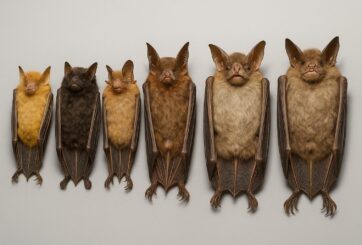
Just in time for Halloween, researchers from the Royal Ontario Museum (ROM), the Field Museum in Chicago, and Lawrence University in Wisconsin have announced the discovery of six new species of bats. These newly identified species, all found in the Philippines, belong to the group known as tube-nosed bats—a fascinating and diverse branch of the mammal family tree. Expanding the Tree of Life Formally recognized as new species through morphological and genetic analysis, this discovery expands the already impressive global…
In a recent study published today in the European Geosciences Union (EGU) journal Biogeosciences, scientists have confirmed that mercury pollution from artisanal and small-scale gold mining (ASGM) is contaminating food crops not through the soil, as previously believed, but directly from the air. Driven by the surging price of gold, which has increased by more than tenfold since 2000, the rapid expansion of unregulated mining in these regions raises urgent questions about food security, human health, and environmental justice The…
A new study from Iceland’s Surtsey island shows that birds carried most of the plants that colonised the island, challenging long-held beliefs that seed or fruit shape determines how plants spread — offering fresh insight into life’s adaptation to c When the volcanic island of Surtsey rose from the North Atlantic Ocean in 1963, it offered scientists a once-in-a-lifetime opportunity to observe how life takes hold on a brand-new and barren land. For decades, ecologists believed that plants’ ability to…
 Feedback
