



Feeding 9 Billion: Innovations in Agricultural Modeling
A popular volcano demonstration in grade school science class rivets students' attention as it spews bubbly liquid over a tabletop, but it comes up short in explaining all the ways that volcanoes form and evolve.
The demonstration – mixing vinegar and baking soda in a clay model of a volcano – is certainly a catchy visual. Nevertheless, such traditional demos are giving way to hands-on activities that can depict the actual forces that caused Washington's Mt. St. Helens to blow or Hawaii's Kilauea to spew red-hot rivers of lava. These new methods still captivate kids, while giving them a better foundation for studying earth science in high school.
Geologists at Rutgers, The State University of New Jersey, working with education specialists, have created three hands-on demonstrations that show how heat and pressure underground move rocks and earth to build up volcanic mountains, and in some cases, cause them to literally blow their tops. These demonstrations have been among the most popular on the Rutgers Science Explorer bus, a hands-on science outreach program that travels to middle schools around the state.
The Rutgers team described its demonstrations this week at the 118th annual meeting of the Geological Society of America in Philadelphia, a gathering of 6,200 academic, government and industrial geoscientists. The presentation was part of a session on improving the understanding of geologic concepts in classes from kindergarten through high school.
“Hands-on projects leave impressions that students take with them into more advanced classes and even into their adult lives,” said Ian Saginor, a doctoral student in geological sciences at Rutgers who studies volcanology in Central America. “Volcanoes continue to captivate young and old, but they are a complex feature of earth science. We felt a need to clarify exactly how they work.”
This knowledge goes beyond casual intrigue or passing high school science. Saginor believes a solid grounding in earth science will prepare students to understand and act on pressing societal issues such as climate change, oil exploration, pollution and species threatened with extinction.
In one of the team's demonstrations, students shoot pieces of sponge, cork and elastic hair ties from miniature air bazookas built out of plastic drinking cups. The sponge bits fly across the room, but the corks fall nearby. The demo shows how lighter material from a volcanic eruption, such as ash, can travel thousands of miles before settling, while rocks and boulders land nearby and often trigger landslides.
Another demonstration shows how volcano debris settles after successive eruptions over thousands or millions of years. Students pour a mixture of dry beans, corn kernels and sunflower seeds into a plastic container and watch as the pieces sort themselves into layers according to size. This helps explain the layering geologists see when they study ancient volcano formations.
The third demonstration uses a slurry of sand and water in a bottle connected by hose to the bottom of a plastic box. When the student lifts the bottle and the slurry starts to flow, the sand forms a crater on the box floor that distinctly resembles a volcanic cinder cone. Besides showing how volcanoes can first form on flat land, it also demonstrates how a lot of pressure causes explosive eruptions while less pressure yields more serene lava and ash flows.




Earthquakes in the American state of Utah, the Soultz-sous-Forêts region of France or in the Dutch province of Groningen should not be able to occur even if the subsurface has been exploited for decades. This is because the shallow subsurface behaves in such a way that faults there become stronger as soon as they start moving. At least that is what geology textbooks teach us. And so, in theory, it should not be possible for earthquakes to occur. So why…
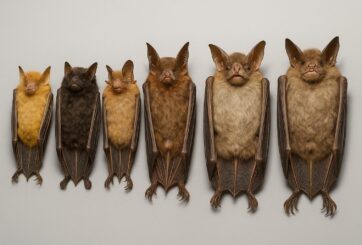
Just in time for Halloween, researchers from the Royal Ontario Museum (ROM), the Field Museum in Chicago, and Lawrence University in Wisconsin have announced the discovery of six new species of bats. These newly identified species, all found in the Philippines, belong to the group known as tube-nosed bats—a fascinating and diverse branch of the mammal family tree. Expanding the Tree of Life Formally recognized as new species through morphological and genetic analysis, this discovery expands the already impressive global…
In a recent study published today in the European Geosciences Union (EGU) journal Biogeosciences, scientists have confirmed that mercury pollution from artisanal and small-scale gold mining (ASGM) is contaminating food crops not through the soil, as previously believed, but directly from the air. Driven by the surging price of gold, which has increased by more than tenfold since 2000, the rapid expansion of unregulated mining in these regions raises urgent questions about food security, human health, and environmental justice The…
A new study from Iceland’s Surtsey island shows that birds carried most of the plants that colonised the island, challenging long-held beliefs that seed or fruit shape determines how plants spread — offering fresh insight into life’s adaptation to c When the volcanic island of Surtsey rose from the North Atlantic Ocean in 1963, it offered scientists a once-in-a-lifetime opportunity to observe how life takes hold on a brand-new and barren land. For decades, ecologists believed that plants’ ability to…
 Feedback
