



Feeding 9 Billion: Innovations in Agricultural Modeling
While the rest of world has warmed, Antarctica has grown chillier, scientists say. According to a new study, air temperature on the southernmost continent fell by 0.7 degree Celsius per decade between 1986 and 2000 – a cooling trend that has come with ecological consequences.
The findings may come as a surprise to climate researchers. Conventional wisdom holds that the polar regions should be the first to show the effects of global warming. And previous work has indeed detected increased temperatures in Antarctica. But those studies, Peter T. Doran of the University of Illinois and colleagues note, used data collected from the Antarctic Peninsula, which extends north toward South America. Doran and his team, in contrast, analyzed a 14-year continuous weather station record from a cold, snow-less desert known as the dry valleys region—the continent’s largest ice-free area. The results of that analysis, in combination with a 35-year continental temperature compilation, suggest that temperature readings from the more numerous Peninsula stations have misrepresented the situation. “Our approach,” Doran remarks, “shows that if you remove the Peninsula from the data set and look at the spatial trend, the majority of the continent is cooling.”
Furthermore, the observed cooling is seasonal, affecting summer and fall temperatures the most. Summer cooling can have an especially dramatic impact on the organisms in Antarctica’s fragile terrestrial ecosystems, where liquid water is of limited availability. In fact, the continent’s cooling trend already appears to have affected life in the dry valleys, the researchers note. Decreased productivity of the region’s lakes may well stem from a climate-induced increase in lake ice thickness, which cuts down on the amount of light that reaches the resident phytoplankton. Changes in the abundance of soil-dwelling invertebrates have occurred as well, the team reports, declining in some cases by 10 percent per year. Prolonged summer cooling, the investigators thus propose, “will diminish aquatic and soil biological assemblages throughout the valleys and possibly in other terrestrial Antarctic ecosystems.”




Earthquakes in the American state of Utah, the Soultz-sous-Forêts region of France or in the Dutch province of Groningen should not be able to occur even if the subsurface has been exploited for decades. This is because the shallow subsurface behaves in such a way that faults there become stronger as soon as they start moving. At least that is what geology textbooks teach us. And so, in theory, it should not be possible for earthquakes to occur. So why…
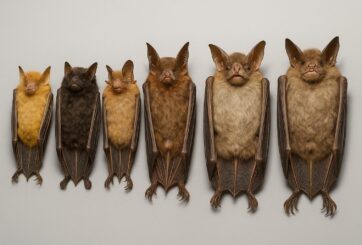
Just in time for Halloween, researchers from the Royal Ontario Museum (ROM), the Field Museum in Chicago, and Lawrence University in Wisconsin have announced the discovery of six new species of bats. These newly identified species, all found in the Philippines, belong to the group known as tube-nosed bats—a fascinating and diverse branch of the mammal family tree. Expanding the Tree of Life Formally recognized as new species through morphological and genetic analysis, this discovery expands the already impressive global…
In a recent study published today in the European Geosciences Union (EGU) journal Biogeosciences, scientists have confirmed that mercury pollution from artisanal and small-scale gold mining (ASGM) is contaminating food crops not through the soil, as previously believed, but directly from the air. Driven by the surging price of gold, which has increased by more than tenfold since 2000, the rapid expansion of unregulated mining in these regions raises urgent questions about food security, human health, and environmental justice The…
A new study from Iceland’s Surtsey island shows that birds carried most of the plants that colonised the island, challenging long-held beliefs that seed or fruit shape determines how plants spread — offering fresh insight into life’s adaptation to c When the volcanic island of Surtsey rose from the North Atlantic Ocean in 1963, it offered scientists a once-in-a-lifetime opportunity to observe how life takes hold on a brand-new and barren land. For decades, ecologists believed that plants’ ability to…
 Feedback
