



Feeding 9 Billion: Innovations in Agricultural Modeling
Fabled equatorial icecaps will disappear within two decades because of global warming, a study led by UCL (University College London) has found.
Reporting online in the journal Geophysical Research Letters, the first survey in a decade of glaciers in the Rwenzori Mountains, East Africa, has found that an increase in air temperature over the last four decades has contributed to a substantial reduction in glacial cover.
The Rwenzori Mountains – also known as the ’Mountains of the Moon’ – straddle the border between the Democratic Republic of Congo and the Republic of Uganda. They are home to one of four remaining tropical ice fields outside of the Andes and are renowned for their spectacular and rare Afroalpine flora and fauna. The mountains’ legendary status was established during the 2nd century when the Greek geographer Ptolemy made the seemingly preposterous but ultimately accurate proclamation that the River Nile was supplied by snow-capped mountains at the equator in Africa: “The Mountains of the Moon whose snows feed the lakes, sources of the Nile”.
The glaciers were first surveyed a century ago when glacial cover over the entire range was estimated to be 6.5 square kilometres. Recent field surveys and satellite mapping of glaciers conducted by UCL with researchers from Makerere University, Uganda and the Ugandan Water Resources Management Department show that some glaciers are receding tens of metres each year and that the area covered by glaciers halved between 1987 and 2003.
The team found that since the 1960s there are clear trends toward increased air temperature around the Rwenzori Mountains without significant changes in precipitation. With less than one square kilometre of glacier ice remaining, glaciers are expected to disappear within the next twenty years if present trends continue.
Dr Richard Taylor, of the UCL Department of Geography who led the study, says:
“Recession of these tropical glaciers sends an unambiguous message of a changing climate in this region of the tropics. Considerable scientific debate exists, however, as to whether changes in temperature or precipitation are responsible for the shrinking of glaciers in the East African Highlands that also include Kilimanjaro and Mount Kenya.”
A key focus of the UCL led research is the impact of climate change on water resources in Africa. Their on-going work highlights that glacial recession in Rwenzori Mountains is not expected to have a significant effect on alpine river flow due to the small size of the remaining glaciers. However, it remains unclear how the projected loss of the glaciers will affect tourism and the traditional belief systems of the local BaKonzo people. Nzururu, the local word for snow and ice, is the father of the spirits who are responsible for human life, its continuity and its welfare.
“Considering the continent’s negligible contribution to global greenhouse-gas emissions, it is a terrible irony that Africa, according to current predictions, will be most affected by climate change,” added Dr Taylor.
“Furthermore, the rise in air temperature is consistent with other regional studies that show how dramatic increases in malaria in the East African Highlands may arise, in part, from warmer temperatures as mosquitoes are able to colonise previously inhospitable highland areas.”
The research was funded by The Royal Geographical Society and The Royal Society.




Earthquakes in the American state of Utah, the Soultz-sous-Forêts region of France or in the Dutch province of Groningen should not be able to occur even if the subsurface has been exploited for decades. This is because the shallow subsurface behaves in such a way that faults there become stronger as soon as they start moving. At least that is what geology textbooks teach us. And so, in theory, it should not be possible for earthquakes to occur. So why…
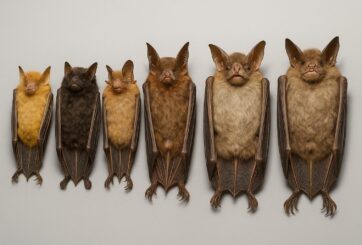
Just in time for Halloween, researchers from the Royal Ontario Museum (ROM), the Field Museum in Chicago, and Lawrence University in Wisconsin have announced the discovery of six new species of bats. These newly identified species, all found in the Philippines, belong to the group known as tube-nosed bats—a fascinating and diverse branch of the mammal family tree. Expanding the Tree of Life Formally recognized as new species through morphological and genetic analysis, this discovery expands the already impressive global…
In a recent study published today in the European Geosciences Union (EGU) journal Biogeosciences, scientists have confirmed that mercury pollution from artisanal and small-scale gold mining (ASGM) is contaminating food crops not through the soil, as previously believed, but directly from the air. Driven by the surging price of gold, which has increased by more than tenfold since 2000, the rapid expansion of unregulated mining in these regions raises urgent questions about food security, human health, and environmental justice The…
A new study from Iceland’s Surtsey island shows that birds carried most of the plants that colonised the island, challenging long-held beliefs that seed or fruit shape determines how plants spread — offering fresh insight into life’s adaptation to c When the volcanic island of Surtsey rose from the North Atlantic Ocean in 1963, it offered scientists a once-in-a-lifetime opportunity to observe how life takes hold on a brand-new and barren land. For decades, ecologists believed that plants’ ability to…
 Feedback
