



Feeding 9 Billion: Innovations in Agricultural Modeling
An enormous iceberg, C-16, rammed into the well-known Drygalski Ice Tongue, a large sheet of glacial ice and snow in the Central Ross Sea in Antarctica, on 30 March 2006, breaking off the tongue’s easternmost tip and forming a new iceberg.
This animation, comprised of images acquired by Envisat’s Advanced Synthetic Aperture Radar (ASAR), shows the iceberg and the ice tongue before and after the collision. On 26 March, C-16 was pinned at the southern edge of the ice tongue but had started migrating by 27 March. The collision on 30 March shows the ice tongue breaking off, and the final image on 1 April captures C-16 and the new iceberg swinging to the other side of the ice tongue.
Mark Drinkwater of ESA’s Ocean and Ice Unit said: “During its passage to the coastal foot of the Drygalski Ice Tongue, C-16, which measures 18.5 kilometres by 55 kilometres, looped into and around McMurdo Sound before being carried quickly to the north.
“The surface ocean currents appear to have predominantly steered the iceberg, not the winds, thus telling us about important aspects of the adjustment in the ocean circulation since the departure of large grounded icebergs off Ross Island.”
The floating Drygalski Ice Tongue, which protrudes 80 kilometres into the ocean, is connected to the David Glacier. If it were to break loose, scientists fear it could alter ocean currents and change the region’s climate.
C-16 was formed in 2000 when Iceberg B-15A, measuring 27 kilometres by 161 kilometres, bumped into the jutting edge of the Ross Ice Shelf and snapped a large piece off. The new iceberg, originally named B-20 and later changed to C-16, then ran aground north of Ross Island. Over the last three months it had escaped its perch and made its way north where it collided with the ice tongue last week.
The National Ice Center (NIC), located in Maryland, USA, names icebergs according to the quadrant in which they are originally sighted. There are four quadrants (A, B, C and D). A sequential number is then assigned to the iceberg. B-20 was first spotted in the B quadrant and was the twentieth iceberg to be logged in that area. When B-20 navigated to the C quadrant, it was renamed to C-16.
NIC named the new iceberg, the piece of the ice tongue which broke off as a result of the C-16 collision, C-25, which measures 13 kilometres by 11 kilometres.
Envisat’s ASAR acquired these images in Wide Swath Mode (WSM), providing spatial resolution of 150 metres. ASAR can pierce through clouds and local darkness and is capable of differentiating between different types of ice.




Earthquakes in the American state of Utah, the Soultz-sous-Forêts region of France or in the Dutch province of Groningen should not be able to occur even if the subsurface has been exploited for decades. This is because the shallow subsurface behaves in such a way that faults there become stronger as soon as they start moving. At least that is what geology textbooks teach us. And so, in theory, it should not be possible for earthquakes to occur. So why…
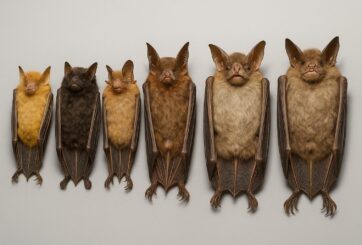
Just in time for Halloween, researchers from the Royal Ontario Museum (ROM), the Field Museum in Chicago, and Lawrence University in Wisconsin have announced the discovery of six new species of bats. These newly identified species, all found in the Philippines, belong to the group known as tube-nosed bats—a fascinating and diverse branch of the mammal family tree. Expanding the Tree of Life Formally recognized as new species through morphological and genetic analysis, this discovery expands the already impressive global…
In a recent study published today in the European Geosciences Union (EGU) journal Biogeosciences, scientists have confirmed that mercury pollution from artisanal and small-scale gold mining (ASGM) is contaminating food crops not through the soil, as previously believed, but directly from the air. Driven by the surging price of gold, which has increased by more than tenfold since 2000, the rapid expansion of unregulated mining in these regions raises urgent questions about food security, human health, and environmental justice The…
A new study from Iceland’s Surtsey island shows that birds carried most of the plants that colonised the island, challenging long-held beliefs that seed or fruit shape determines how plants spread — offering fresh insight into life’s adaptation to c When the volcanic island of Surtsey rose from the North Atlantic Ocean in 1963, it offered scientists a once-in-a-lifetime opportunity to observe how life takes hold on a brand-new and barren land. For decades, ecologists believed that plants’ ability to…
 Feedback
