



Feeding 9 Billion: Innovations in Agricultural Modeling
If you’re a scientist studying the surface of Mars, few discoveries could be more exciting than seeing recent gullies apparently formed by running water.
And that’s what scientists believed they saw in Mars Orbital Camera (MOC) images five years ago. They published a paper in Science on MOC images that show small, geologically young ravines. They concluded that the gullies are evidence that liquid water flowed on Mars’ surface sometime within the last million years.
A word of caution, though: The moon has gullies that look like that, a University of Arizona Lunar and Planetary Laboratory researcher has found. And water certainly didn’t form gullies on the waterless moon.
Gwendolyn D. Bart is presenting the work today at the 37th Lunar and Planetary Science Conference in Houston.
“We’d all like to find liquid water on Mars,” Bart said. “That would be really, really exciting. If there were liquid water on Mars, humans wouldn’t have to ship water from Earth when they go to explore the planet. That would be an enormous cost savings. And liquid water near the surface of Mars would greatly increase the chances for native life on Mars.”
The 2000 Science paper was provocative, Bart said. “But I was skeptical. I wondered if there is another explanation for the gullies.”
Then last year she heard a talk by Allan Treiman of the Lunar and Planetary Institute. Treiman suggested the martian gullies might be dry landslides, perhaps formed by wind and not formed by water at all.
Recently, Bart was studying the lunar landscape in high-resolution images taken in 1969, prior to the Apollo landings, for her research on processes that modify the lunar surface.
“Totally by accident, I saw gullies that looked strikingly like the gullies on Mars,” she said.
“If the dry landslide hypothesis for the formation of martian gullies is correct, we might expect to see similar features on the moon, where there is no water,” she said. “We do.”
Gullies in the moon’s 10-mile-diameter (17 kilometer) crater Dawes are similar in structure and size to those in a martian crater that MOC photographed. Micrometeorites hitting the smooth slopes and crater on the airless moon could easily trigger small avalanches that form gullies, Bart said.
However, the martian gullies also resemble gullies on Earth that were formed by water, she noted.
“My point is that you can’t just look at the Mars gullies and assume they were formed by water. It may be, or may be not. We need another test to know.”




Earthquakes in the American state of Utah, the Soultz-sous-Forêts region of France or in the Dutch province of Groningen should not be able to occur even if the subsurface has been exploited for decades. This is because the shallow subsurface behaves in such a way that faults there become stronger as soon as they start moving. At least that is what geology textbooks teach us. And so, in theory, it should not be possible for earthquakes to occur. So why…
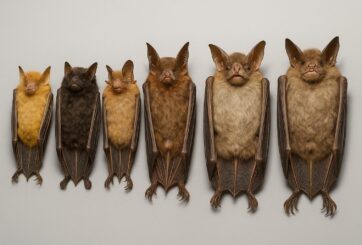
Just in time for Halloween, researchers from the Royal Ontario Museum (ROM), the Field Museum in Chicago, and Lawrence University in Wisconsin have announced the discovery of six new species of bats. These newly identified species, all found in the Philippines, belong to the group known as tube-nosed bats—a fascinating and diverse branch of the mammal family tree. Expanding the Tree of Life Formally recognized as new species through morphological and genetic analysis, this discovery expands the already impressive global…
In a recent study published today in the European Geosciences Union (EGU) journal Biogeosciences, scientists have confirmed that mercury pollution from artisanal and small-scale gold mining (ASGM) is contaminating food crops not through the soil, as previously believed, but directly from the air. Driven by the surging price of gold, which has increased by more than tenfold since 2000, the rapid expansion of unregulated mining in these regions raises urgent questions about food security, human health, and environmental justice The…
A new study from Iceland’s Surtsey island shows that birds carried most of the plants that colonised the island, challenging long-held beliefs that seed or fruit shape determines how plants spread — offering fresh insight into life’s adaptation to c When the volcanic island of Surtsey rose from the North Atlantic Ocean in 1963, it offered scientists a once-in-a-lifetime opportunity to observe how life takes hold on a brand-new and barren land. For decades, ecologists believed that plants’ ability to…
 Feedback
