



Feeding 9 Billion: Innovations in Agricultural Modeling
The Volvo Ocean Race yachts have safely rounded Cape Horn on the fourth leg of their round-the-world adventure thanks to the help of radar satellites steering them away from dangerous icebergs.
While all the legs of the race have their unique dangers, Volvo Ocean Race Meteorologist Chris Bedford said leg four is arguably the most dangerous. “The boats have to face 50-knot storms, massive seas and possible ice, and if something happens on the leg, help is many hours and, more likely, days away.”
C-CORE, a Canadian company providing Earth observation based geo-information services, supplied ‘pre-leg’ reconnaissance of the areas in the Southern Ocean notorious for harbouring icebergs by using data acquired by the ESA’s Envisat and the Canadian Space Agency’s (CSA) RADARSAT-1 satellites.
Within a few hours of the satellites collecting the data with Synthetic Aperture Radar (SAR), C-CORE received and processed it using a specialised Iceberg Detection Software. The results, which included iceberg targets, their size and shape and longitude and latitude information, were then forwarded to Bedford, who provided it to the crews.
“The C-CORE service has been a huge help in allowing us to set the course in such a manner as to keep the team away from potential ice,” Bedford said. “In addition, the crews were able to leave the dock with a reasonable idea of where the ice was most likely to be.”
Knowing where the ice was most likely to be was helpful to sailors who still had to be vigilant and weary of ‘growlers’ – smaller bits of ice that break away from main icebergs and do not show up on radar. Growlers can be the size of a small car and are extremely dangerous and difficult to spot by eye, especially when travelling at full speed during rough seas at night.
“I’m relieved that I got through another amazing Southern Ocean trip in one piece, but also somewhat sad. Every time I get to this part of a round-the-world trip I look over my shoulder at Cape Horn and just wonder: will I be coming down here again? If not, thank you Southern Ocean for letting me cross you safely and for those unforgettable experiences,” Ericsson skipper Neal McDonald wrote to race headquarters via email.
The Volvo Ocean Race, which takes place every four years, is a 31 250 nautical mile round-the-world race comprised of nine legs. The fourth leg covers 6 700 miles from Wellington, New Zealand, to Rio de Janeiro, Brasil, via Cape Horn.
C-CORE is funded under The Polar View initiative and is part of Global Monitoring for Environment and Security (GMES), a joint initiative by the ESA and the European Commission to establish an independent global monitoring capacity in support of European policy goals.




Earthquakes in the American state of Utah, the Soultz-sous-Forêts region of France or in the Dutch province of Groningen should not be able to occur even if the subsurface has been exploited for decades. This is because the shallow subsurface behaves in such a way that faults there become stronger as soon as they start moving. At least that is what geology textbooks teach us. And so, in theory, it should not be possible for earthquakes to occur. So why…
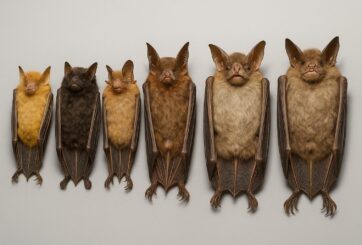
Just in time for Halloween, researchers from the Royal Ontario Museum (ROM), the Field Museum in Chicago, and Lawrence University in Wisconsin have announced the discovery of six new species of bats. These newly identified species, all found in the Philippines, belong to the group known as tube-nosed bats—a fascinating and diverse branch of the mammal family tree. Expanding the Tree of Life Formally recognized as new species through morphological and genetic analysis, this discovery expands the already impressive global…
In a recent study published today in the European Geosciences Union (EGU) journal Biogeosciences, scientists have confirmed that mercury pollution from artisanal and small-scale gold mining (ASGM) is contaminating food crops not through the soil, as previously believed, but directly from the air. Driven by the surging price of gold, which has increased by more than tenfold since 2000, the rapid expansion of unregulated mining in these regions raises urgent questions about food security, human health, and environmental justice The…
A new study from Iceland’s Surtsey island shows that birds carried most of the plants that colonised the island, challenging long-held beliefs that seed or fruit shape determines how plants spread — offering fresh insight into life’s adaptation to c When the volcanic island of Surtsey rose from the North Atlantic Ocean in 1963, it offered scientists a once-in-a-lifetime opportunity to observe how life takes hold on a brand-new and barren land. For decades, ecologists believed that plants’ ability to…
 Feedback
