



Feeding 9 Billion: Innovations in Agricultural Modeling
The co-dependence of mortality risk and poverty
The Indian Ocean tsunami, the Katrina hurricane catastrophe and the Pakistan earthquake in late 2005 bear disquieting similarities in their consequences on human populations. The tsunami took 300,000 lives with more than 100,000 still missing. Although many of the missing may well be displaced rather than casualties, the death toll will likely remain in excess of 300,000. Early images from the catastrophe would have lead one to believe that tourist were preferentially impacted, but the world soon learned that this was due to the fact that tourists were the only ones with video equipment at the ready. In fact, the great majority of those who perished were relatively poor people; many of them subsistence level fishermen, and met their fate away from the cameras lens. These people contributed little to the formal economy and because of this the economic impact of the tsunami is unclear. Insured property losses were small not because little property was lost but because so little was insured.
As a result, the tsunami disaster underscores the well-supported observation that people in the lower rungs of society around the world are at far greater mortality risk from natural disasters than those who are better off. The Magnitude 7.6 October 2005 earthquake in Pakistan, for example, took the lives of more than 30,000 people while the Northridge earthquake in California took less than 100 lives. Countries that fall lowest on measures such as the Human Development Index, such as the poorest countries in Africa, are known to suffer much greater losses than richer countries. This is likely due in part to the prevalence of structures and inadequate emergency response institutions, but the vulnerability of the poor is also amplified by where they live, which is often in regions prone to flooding and landslides or in regions susceptible to climate extremes.
Presenter: John Mutter, Deputy Director, The Earth Institute at Columbia University
Track: Mathematics and Statistics
Date: Sunday, February 19, 2006
Time: 10:30 a.m. to 12:00 noon




Earthquakes in the American state of Utah, the Soultz-sous-Forêts region of France or in the Dutch province of Groningen should not be able to occur even if the subsurface has been exploited for decades. This is because the shallow subsurface behaves in such a way that faults there become stronger as soon as they start moving. At least that is what geology textbooks teach us. And so, in theory, it should not be possible for earthquakes to occur. So why…
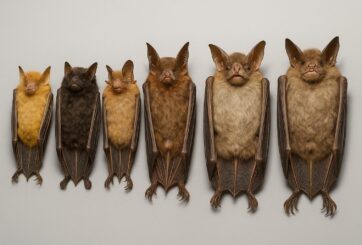
Just in time for Halloween, researchers from the Royal Ontario Museum (ROM), the Field Museum in Chicago, and Lawrence University in Wisconsin have announced the discovery of six new species of bats. These newly identified species, all found in the Philippines, belong to the group known as tube-nosed bats—a fascinating and diverse branch of the mammal family tree. Expanding the Tree of Life Formally recognized as new species through morphological and genetic analysis, this discovery expands the already impressive global…
In a recent study published today in the European Geosciences Union (EGU) journal Biogeosciences, scientists have confirmed that mercury pollution from artisanal and small-scale gold mining (ASGM) is contaminating food crops not through the soil, as previously believed, but directly from the air. Driven by the surging price of gold, which has increased by more than tenfold since 2000, the rapid expansion of unregulated mining in these regions raises urgent questions about food security, human health, and environmental justice The…
A new study from Iceland’s Surtsey island shows that birds carried most of the plants that colonised the island, challenging long-held beliefs that seed or fruit shape determines how plants spread — offering fresh insight into life’s adaptation to c When the volcanic island of Surtsey rose from the North Atlantic Ocean in 1963, it offered scientists a once-in-a-lifetime opportunity to observe how life takes hold on a brand-new and barren land. For decades, ecologists believed that plants’ ability to…
 Feedback
