



Feeding 9 Billion: Innovations in Agricultural Modeling
All through the ages, humans have dreamily gazed at those shape-shifting cotton-balls floating gently across the sky-the clouds.
Atmospheric scientists-Earth’s professional cloud-gazers–have learned a great deal about clouds over the decades, particularly with the advent of satellites during the 1960s and 70s. But despite years of research and the emergence of increasingly sophisticated tools, scientists are still at odds over one of the most basic issues of all: how to define a cloud.
“The problem is that what we define a cloud as depends on the type of instrument we’re using to define it,” says atmospheric scientist Steven Ackerman, the director of the Cooperative Institute for Meteorological Satellite Studies at the University of Wisconsin-Madison. It’s an issue Ackerman will discuss today (Dec. 8, 2005) at the fall meeting of the American Geophysical Union, which runs Dec. 5-9.
It is critical to define and measure clouds accurately, notes Ackerman, because their patterns and formations play an important role in shaping both weather forecasts and longer-term climate predictions. Clouds are also a crucial part of Earth’s hydrological and energy cycles, both regulating atmospheric precipitation and determining how much solar energy reaches the Earth.
A number of issues, however, make measurements of planetary cloud cover a very “fuzzy” matter, Ackerman says. Orbiting satellites, for instance, make different types of cloud observations from space. In one approach – known as “active sensing” – satellites discern the presence of clouds by directing energy of varying wavelengths at successive sections of the atmosphere.
The problem, says Ackerman, is that varying that energy threshold by just 3-4 percent can significantly alter cloud cover measurements. Different satellites also introduce variation, with readings differing by up to 5-10 percent between instruments. “It’s like assigning grades,” says Ackerman. “If you score 90 and above you get an A; but what if someone gets 89.8 and gets a B? Is that fair? Well that’s the same problem with measuring clouds.”
Cirrus clouds – wispy, long formations that almost look like smoke – are particularly problematic to define. As these clouds taper off into nothingness, scientists often struggle to define the point at which they cease to be clouds, says Ackerman. Furthermore, as satellites scan consecutive blocks of the atmosphere, making readings can get pretty tricky, he adds. “An [observation] area may contain different types of clouds or may be half-full of cloud or packed with thick cloud-so then we’re asking: is that a cloud or not a cloud?”
Over the years, scientists have periodically gathered to refine the science of cloud measurements. It may be time again for that larger discussion, says Ackerman.




Earthquakes in the American state of Utah, the Soultz-sous-Forêts region of France or in the Dutch province of Groningen should not be able to occur even if the subsurface has been exploited for decades. This is because the shallow subsurface behaves in such a way that faults there become stronger as soon as they start moving. At least that is what geology textbooks teach us. And so, in theory, it should not be possible for earthquakes to occur. So why…
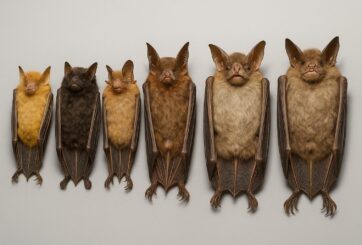
Just in time for Halloween, researchers from the Royal Ontario Museum (ROM), the Field Museum in Chicago, and Lawrence University in Wisconsin have announced the discovery of six new species of bats. These newly identified species, all found in the Philippines, belong to the group known as tube-nosed bats—a fascinating and diverse branch of the mammal family tree. Expanding the Tree of Life Formally recognized as new species through morphological and genetic analysis, this discovery expands the already impressive global…
In a recent study published today in the European Geosciences Union (EGU) journal Biogeosciences, scientists have confirmed that mercury pollution from artisanal and small-scale gold mining (ASGM) is contaminating food crops not through the soil, as previously believed, but directly from the air. Driven by the surging price of gold, which has increased by more than tenfold since 2000, the rapid expansion of unregulated mining in these regions raises urgent questions about food security, human health, and environmental justice The…
A new study from Iceland’s Surtsey island shows that birds carried most of the plants that colonised the island, challenging long-held beliefs that seed or fruit shape determines how plants spread — offering fresh insight into life’s adaptation to c When the volcanic island of Surtsey rose from the North Atlantic Ocean in 1963, it offered scientists a once-in-a-lifetime opportunity to observe how life takes hold on a brand-new and barren land. For decades, ecologists believed that plants’ ability to…
 Feedback
