



Feeding 9 Billion: Innovations in Agricultural Modeling
The Natural Disaster Hotspots report released earlier this year showed that the U.S. Gulf Coast is among the world’s most at-risk regions in terms of human mortality and economic loss due to storms like Katrina and Rita.
The study, which was produced by researchers from the Center for Hazards and Risk Research, The International Research Institute for Climate Prediction (IRI), the Center for International Earth Science Information Network (CIESIN), the Lamont-Doherty Earth Observatory and the World Bank, estimated risk levels by combining hazard exposure with historical vulnerability for two indicators of elements at risk—gridded population and Gross Domestic Product (GDP) per unit area—for six major natural hazards: earthquakes, volcanoes, landslides, floods, drought and cyclones (which are called hurricanes in the North Atlantic and Eastern North Pacific).
By calculating relative risks for each grid cell rather than for countries as a whole, the study was able to estimate risk levels at sub-national scales. Such information can help inform a range of disaster prevention and preparedness measures, including prioritization of resources, targeting of more localized and detailed risk assessments, implementation of risk-based disaster management and emergency response strategies, and development of long-term land-use plans and multihazard risk management strategies.




Earthquakes in the American state of Utah, the Soultz-sous-Forêts region of France or in the Dutch province of Groningen should not be able to occur even if the subsurface has been exploited for decades. This is because the shallow subsurface behaves in such a way that faults there become stronger as soon as they start moving. At least that is what geology textbooks teach us. And so, in theory, it should not be possible for earthquakes to occur. So why…
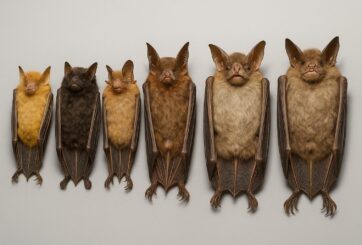
Just in time for Halloween, researchers from the Royal Ontario Museum (ROM), the Field Museum in Chicago, and Lawrence University in Wisconsin have announced the discovery of six new species of bats. These newly identified species, all found in the Philippines, belong to the group known as tube-nosed bats—a fascinating and diverse branch of the mammal family tree. Expanding the Tree of Life Formally recognized as new species through morphological and genetic analysis, this discovery expands the already impressive global…
In a recent study published today in the European Geosciences Union (EGU) journal Biogeosciences, scientists have confirmed that mercury pollution from artisanal and small-scale gold mining (ASGM) is contaminating food crops not through the soil, as previously believed, but directly from the air. Driven by the surging price of gold, which has increased by more than tenfold since 2000, the rapid expansion of unregulated mining in these regions raises urgent questions about food security, human health, and environmental justice The…
A new study from Iceland’s Surtsey island shows that birds carried most of the plants that colonised the island, challenging long-held beliefs that seed or fruit shape determines how plants spread — offering fresh insight into life’s adaptation to c When the volcanic island of Surtsey rose from the North Atlantic Ocean in 1963, it offered scientists a once-in-a-lifetime opportunity to observe how life takes hold on a brand-new and barren land. For decades, ecologists believed that plants’ ability to…
 Feedback
