



Feeding 9 Billion: Innovations in Agricultural Modeling
Scientists using satellite imagery found that at least 23 percent of the water released from the mouth of the Mississippi River from July through September 2004 traveled quite a distance – into the Gulf of Mexico, around the Florida Keys, and into the Atlantic Ocean.
The researchers combined data from the Moderate Resolution Imaging Spectroradiometer (MODIS) aboard NASA’s Terra and Aqua satellites with information collected from ships to study the water discharge, appearing as a dark plume that stretched from the Mississippi Delta, around Florida and up to the Georgia coast. MODIS detects the color of the ocean due to changes in the amount of tiny ocean plants floating on the ocean’s surface known as phytoplankton, or algae and other decaying materials.
“This is the first time we have been able to estimate the amount or volume of freshwater discharged and carried over such remote distances. By combining the very detailed data from MODIS with observations from ships, we got a three-dimensional view of the Mississippi plume,” said Chuanmin Hu, of the College of Marine Science, University of South Florida, St. Petersburg, Fla., and lead author of the study. By using MODIS data with information on sea surface currents and sea salt levels (salinity), the scientists estimated that about 20 billion tons of Mississippi River water reached the Florida Straits and Gulf Stream off the Georgia coast. This is about four times the volume of Lake Okeechobee, the largest lake in Florida.
The research also shows that such plumes created by the Mississippi River can travel over large distances, more than 1240 miles (2000 kilometers).
Beyond studying the causes of such events, researchers are using satellite information with observations from ships and “ocean surface drifters” – instruments resembling balloons that travel the ocean surface, to get a better idea of how these plumes affect marine life.
“Mississippi River water may have some impact on marine life in remote delicate ecosystems like the Florida Keys. But we are still not clear about the potential impacts of pollutants and pesticides,” said Hu. “Not all effects will be bad; in fact, some light dark water events might actually protect bottom ocean dwellers, like coral, by providing them with shade.”
The study is published in the July 2005 issue of Geophysical Research Letters under support of NASA, NOAA, and ONR as a contribution to the SouthEast Atlantic Coastal Ocean Observing System (SEACOOS). Coauthors include oceanographers James Nelson from the Skidaway Institute of Oceanography, Elizabeth Johns from NOAA’s Atlantic Oceanographic and Meteorological Laboratory, and Zhiqiang Chen, Robert Weisberg, and Frank Muller-Karger from the University of South Florida.




Earthquakes in the American state of Utah, the Soultz-sous-Forêts region of France or in the Dutch province of Groningen should not be able to occur even if the subsurface has been exploited for decades. This is because the shallow subsurface behaves in such a way that faults there become stronger as soon as they start moving. At least that is what geology textbooks teach us. And so, in theory, it should not be possible for earthquakes to occur. So why…
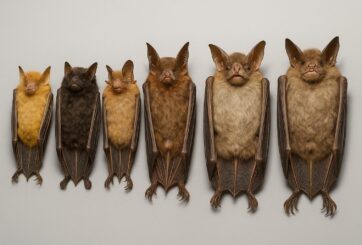
Just in time for Halloween, researchers from the Royal Ontario Museum (ROM), the Field Museum in Chicago, and Lawrence University in Wisconsin have announced the discovery of six new species of bats. These newly identified species, all found in the Philippines, belong to the group known as tube-nosed bats—a fascinating and diverse branch of the mammal family tree. Expanding the Tree of Life Formally recognized as new species through morphological and genetic analysis, this discovery expands the already impressive global…
In a recent study published today in the European Geosciences Union (EGU) journal Biogeosciences, scientists have confirmed that mercury pollution from artisanal and small-scale gold mining (ASGM) is contaminating food crops not through the soil, as previously believed, but directly from the air. Driven by the surging price of gold, which has increased by more than tenfold since 2000, the rapid expansion of unregulated mining in these regions raises urgent questions about food security, human health, and environmental justice The…
A new study from Iceland’s Surtsey island shows that birds carried most of the plants that colonised the island, challenging long-held beliefs that seed or fruit shape determines how plants spread — offering fresh insight into life’s adaptation to c When the volcanic island of Surtsey rose from the North Atlantic Ocean in 1963, it offered scientists a once-in-a-lifetime opportunity to observe how life takes hold on a brand-new and barren land. For decades, ecologists believed that plants’ ability to…
 Feedback
