



Feeding 9 Billion: Innovations in Agricultural Modeling
The Arctic and Antarctic evoke images of virgin territories playing host to a rich variety of flora, fauna and indigenous populations, but also a hardy group of intrepid researchers and explorers. A special issue of RTD info, produced with the International Polar Foundation, joins the exploration of the poles’ vast scientific wonders.
The European Commission’s flagship research publication RTD info takes readers on a journey to the ends of the Earth in its exploration of polar research. “A voyage to the polar regions of the world is also a trip through time and history,” notes the special issue of RTD info. For climate researchers, the poles are a frozen archive of global climatic change, helping them unravel what has happened in the past to better understand the future. Sample cores drilled from deep polar ice sheets allow scientists to monitor the impact of global warming and validate simulation models of future changes to the Earth’s climate system.
This issue describes the leading role that European teams are playing in diverse scientific fields – including glaciology, climatology, astronomy and the life sciences – and the importance of international co-operation in this research. Because of the harsh, cold and remote working conditions, “polar researchers … often rely on specially adapted methods and technologies to carry out their work”. This makes it a complex and costly activity, but essential nonetheless. And the more scientists learn about the two poles, the more striking their differences appear. With a long history of human settlement in the Arctic, research activities – i.e. marine biology and environmental studies – are more developed than in Antarctica. But the south is catching up fast, spearheaded by international collaborative efforts made possible by the signing of the Antarctic Treaty in 1959.
In one section of the 44-page magazine, readers discover how polar fauna and flora are coping with major climate warming. But also how seasonal changes in the Arctic are affecting native populations, such as the Dolgans, Inuits and Saami who are all struggling to keep up their hunting and herding traditions. RTD info climbs aboard icebreaker ships – floating labs for scientists to carry out experiments – travels into space to explore how satellites are tracking ice and vegetation patterns in the poles, and tours the leading European and international institutes and organisations working on polar research.
The issue is capped off by an interview with Alain Hubert, a Belgian polar explorer and co-founder of the International Polar Foundation (IPF), who talks about the importance of communicating polar research to the public. In fact, this special issue was made possible thanks to major contributions from the IPF, which was set up in 2002 to keep society informed on scientific research – especially relating to climate change – in the polar regions.
RTD info is essential reading for anyone interested in science and research. You can obtain a free copy by e-mailing to research@cec.eu.int or read it on-line at:
http://www.europa.eu.int/comm/research/rtdinfo/special_ms/index_en.htm




Earthquakes in the American state of Utah, the Soultz-sous-Forêts region of France or in the Dutch province of Groningen should not be able to occur even if the subsurface has been exploited for decades. This is because the shallow subsurface behaves in such a way that faults there become stronger as soon as they start moving. At least that is what geology textbooks teach us. And so, in theory, it should not be possible for earthquakes to occur. So why…
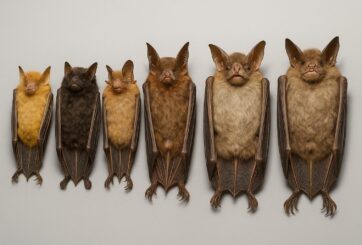
Just in time for Halloween, researchers from the Royal Ontario Museum (ROM), the Field Museum in Chicago, and Lawrence University in Wisconsin have announced the discovery of six new species of bats. These newly identified species, all found in the Philippines, belong to the group known as tube-nosed bats—a fascinating and diverse branch of the mammal family tree. Expanding the Tree of Life Formally recognized as new species through morphological and genetic analysis, this discovery expands the already impressive global…
In a recent study published today in the European Geosciences Union (EGU) journal Biogeosciences, scientists have confirmed that mercury pollution from artisanal and small-scale gold mining (ASGM) is contaminating food crops not through the soil, as previously believed, but directly from the air. Driven by the surging price of gold, which has increased by more than tenfold since 2000, the rapid expansion of unregulated mining in these regions raises urgent questions about food security, human health, and environmental justice The…
A new study from Iceland’s Surtsey island shows that birds carried most of the plants that colonised the island, challenging long-held beliefs that seed or fruit shape determines how plants spread — offering fresh insight into life’s adaptation to c When the volcanic island of Surtsey rose from the North Atlantic Ocean in 1963, it offered scientists a once-in-a-lifetime opportunity to observe how life takes hold on a brand-new and barren land. For decades, ecologists believed that plants’ ability to…
 Feedback
