



Feeding 9 Billion: Innovations in Agricultural Modeling
The intense mechanical testing period is finally over for the CryoSat satellite, and with launch just a couple of months away – the very last checks are being made before the spacecraft is packed up and shipped to the launch site in Plesetsk, Russia.
During the last 12 months the satellite has been undergoing stringent mechanical and environmental tests at the Space Test Centre at IABG (Industrieanlagen-Betriebsgesellschaft mbH) in Ottobrunn, Germany. Unfortunately, some concerns were raised about how a few of the components were functioning and consequently, repair and replacement activities hampered the testing programme and slightly delayed the launch date. Now, however, there just remains the final software checks before the satellite and its support equipment are packaged for the long voyage to Russia for launch at the end of September.
The last phase of the testing programme focused on rigorous acoustic tests, which subjected the satellite to the same levels of noise that it will be exposed to during launch. CryoSat will be launched on a Rockot launch vehicle from the remote Plesetsk Cosmodrome about 800 km north of Moscow in Russia. Rockot is one of the modified Russian Intercontinental Ballistic Missile (ICBM) SS-19 launchers, which were decommissioned as a result of the Strategic Arms Reduction Treaty in 1991. The adaptation of the SS-19 uses the original two lower liquid propellant stages of the ICBM in conjunction with a new ’Breeze-KM’ third stage for commercial payloads.
A few weeks before the acoustic tests were carried out CryoSat underwent thermal balance and vacuum testing. This part of the programme ensured that the satellite will function properly in the harsh environment that space presents. The spacecraft was oriented in various positions in the ’Sun chamber’ to simulate, as accurately as possible, the various degrees of heat that the spacecraft will encounter during its unusual polar-orbiting lifetime.
Now that the crucial testing period is over the CryoSat team is preparing for the launch campaign and the operations planned during the early life of the satellite in orbit.
It has taken just six years for CryoSat to go from a proposal idea to a full satellite mission about to be launched. Dedicated to monitoring precise changes in the thickness of the polar ice sheets and floating sea ice, CryoSat is the first Earth Explorer mission to be realised as part of ESA’s Living Planet Programme. The observations made over the three-year lifetime of the mission will provide conclusive evidence of rates at which ice cover may be diminishing as a result of global warming.




Earthquakes in the American state of Utah, the Soultz-sous-Forêts region of France or in the Dutch province of Groningen should not be able to occur even if the subsurface has been exploited for decades. This is because the shallow subsurface behaves in such a way that faults there become stronger as soon as they start moving. At least that is what geology textbooks teach us. And so, in theory, it should not be possible for earthquakes to occur. So why…
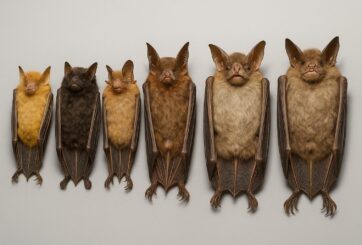
Just in time for Halloween, researchers from the Royal Ontario Museum (ROM), the Field Museum in Chicago, and Lawrence University in Wisconsin have announced the discovery of six new species of bats. These newly identified species, all found in the Philippines, belong to the group known as tube-nosed bats—a fascinating and diverse branch of the mammal family tree. Expanding the Tree of Life Formally recognized as new species through morphological and genetic analysis, this discovery expands the already impressive global…
In a recent study published today in the European Geosciences Union (EGU) journal Biogeosciences, scientists have confirmed that mercury pollution from artisanal and small-scale gold mining (ASGM) is contaminating food crops not through the soil, as previously believed, but directly from the air. Driven by the surging price of gold, which has increased by more than tenfold since 2000, the rapid expansion of unregulated mining in these regions raises urgent questions about food security, human health, and environmental justice The…
A new study from Iceland’s Surtsey island shows that birds carried most of the plants that colonised the island, challenging long-held beliefs that seed or fruit shape determines how plants spread — offering fresh insight into life’s adaptation to c When the volcanic island of Surtsey rose from the North Atlantic Ocean in 1963, it offered scientists a once-in-a-lifetime opportunity to observe how life takes hold on a brand-new and barren land. For decades, ecologists believed that plants’ ability to…
 Feedback
