



Feeding 9 Billion: Innovations in Agricultural Modeling
Researchers from the Integrated Ocean Drilling Program (IODP) have drilled into sections of the Earth’s crust for the first time ever, and their findings could provide new insights about how Earth was formed.
Scientists aboard the research vessel JOIDES Resolution, of which Texas A&M University serves as the chief contractor, took almost three months to drill the hole, which penetrates more than 4,600 feet below the ocean floor. It is in an area called the Atlantis Massif located in the middle of the Atlantic Ocean, says Jay Miller, staff scientist at Texas A&M and one of the leaders of the project.
The new hole – the third deepest ever drilled in the “basement” area of the oceanic crust – has provided more than 3,000 feet of core samples that researchers will examine over the next three to four years, Miller said. It could provide key data on how ocean crust and other layers form, and the research may yield new perspectives on how the ocean crust was formed and has evolved through time.
“What we know about how the interior of the Earth evolved is based primarily on geophysical data,” Miller explains.
“The samples we’ve collected lead us to believe that we’ve oversimplified some features. We know now that each time we drill a hole, we learn the structure of the Earth is much more complex than we had thought. Much of this drilling work is changing our understanding of how the Earth developed.”
Drilling during the expedition, which was completed in early March, lasted 24 hours a day through solid rock, Miller said. Research teams from IODP’s members (the United States, Japan, China and the European Consortium for Ocean Research) involved 18 different countries.
Miller said the core samples will be analyzed and additional drilling could be possible. “The area where we were is sort of a mountain on the ocean floor,” he explains. “The data from where we drilled also need to be studied thoroughly so we can develop a model to work from. This could provide us with a window to parts of the oceanic crust we’ve never seen. “From these samples, we hope to assemble pictures and data of what the entire ocean crust looks like. This hole we’ve drilled is just one part of the big puzzle below the ocean floor.”
Miller said the 4,600-foot hole “is still there, open and in good condition. We could return to it at any time in the future and deepen it.”




Earthquakes in the American state of Utah, the Soultz-sous-Forêts region of France or in the Dutch province of Groningen should not be able to occur even if the subsurface has been exploited for decades. This is because the shallow subsurface behaves in such a way that faults there become stronger as soon as they start moving. At least that is what geology textbooks teach us. And so, in theory, it should not be possible for earthquakes to occur. So why…
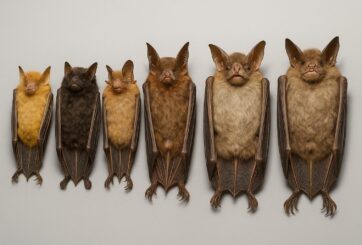
Just in time for Halloween, researchers from the Royal Ontario Museum (ROM), the Field Museum in Chicago, and Lawrence University in Wisconsin have announced the discovery of six new species of bats. These newly identified species, all found in the Philippines, belong to the group known as tube-nosed bats—a fascinating and diverse branch of the mammal family tree. Expanding the Tree of Life Formally recognized as new species through morphological and genetic analysis, this discovery expands the already impressive global…
In a recent study published today in the European Geosciences Union (EGU) journal Biogeosciences, scientists have confirmed that mercury pollution from artisanal and small-scale gold mining (ASGM) is contaminating food crops not through the soil, as previously believed, but directly from the air. Driven by the surging price of gold, which has increased by more than tenfold since 2000, the rapid expansion of unregulated mining in these regions raises urgent questions about food security, human health, and environmental justice The…
A new study from Iceland’s Surtsey island shows that birds carried most of the plants that colonised the island, challenging long-held beliefs that seed or fruit shape determines how plants spread — offering fresh insight into life’s adaptation to c When the volcanic island of Surtsey rose from the North Atlantic Ocean in 1963, it offered scientists a once-in-a-lifetime opportunity to observe how life takes hold on a brand-new and barren land. For decades, ecologists believed that plants’ ability to…
 Feedback
