



Feeding 9 Billion: Innovations in Agricultural Modeling
Deep ocean research stretching from the Arctic to the Black Sea is to receive 15 million euros (around £10 million sterling) as part of a programme involving 15 countries across Europe.
Led by Southampton Oceanography Centre’s Professor Phil Weaver, the HERMES project (Hotspot Ecosystem Research on the Margins of European Seas) will study ecosystems along Europe’s deep-ocean margin and is one of the largest research projects of its kind.
HERMES will bring together leading experts in biodiversity, geology, sedimentology, physical oceanography, microbiology and biogeochemistry, as well as experts in socio-economics. This represents the first major attempt to understand European deep-water ecosystems and their environment in an integrated way.
Scientists will investigate life on the deep ocean margin at a number of study sites extending from the Arctic down to the Gulf of Cadiz, and through the Mediterranean to the Black Sea. These sites encompass a wide range of ecosystems, from open slopes where biological communities are affected by landslides and deep-ocean currents, to ecosystem hotspots such as communities dependent on fluids escaping from the seabed (cold seeps), cold-water coral mounds, canyon communities and anoxic environments.
Professor Weaver explains: ‘These systems are incredibly fragile and need urgent study. A key goal of the HERMES project is to evaluate the vulnerability of these communities to global change and human activities, and if necessary, develop strategies to protect them. The outcome of our research will provide policy advice to the EU.’
Over the next four years the project will make full use of the latest deep-sea technology. Information on deep sea life along the European margin will be gathered on a large number of research cruises, including some that will use Remotely Operated Vehicles (ROVs) from Southampton Oceanography Centre, the French research institute, IFREMER, and from the University of Bremen.
HERMES started in April 2005 and will run for four years. EC funding is provided from the Framework Six Programme – Global Change and Ecosystems. The HERMES consortium is made up of 36 research institutes and nine small businesses from 15 European countries.




Earthquakes in the American state of Utah, the Soultz-sous-Forêts region of France or in the Dutch province of Groningen should not be able to occur even if the subsurface has been exploited for decades. This is because the shallow subsurface behaves in such a way that faults there become stronger as soon as they start moving. At least that is what geology textbooks teach us. And so, in theory, it should not be possible for earthquakes to occur. So why…
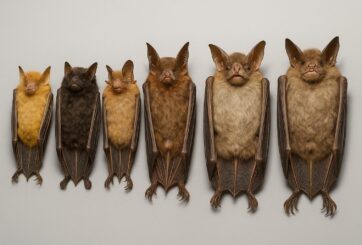
Just in time for Halloween, researchers from the Royal Ontario Museum (ROM), the Field Museum in Chicago, and Lawrence University in Wisconsin have announced the discovery of six new species of bats. These newly identified species, all found in the Philippines, belong to the group known as tube-nosed bats—a fascinating and diverse branch of the mammal family tree. Expanding the Tree of Life Formally recognized as new species through morphological and genetic analysis, this discovery expands the already impressive global…
In a recent study published today in the European Geosciences Union (EGU) journal Biogeosciences, scientists have confirmed that mercury pollution from artisanal and small-scale gold mining (ASGM) is contaminating food crops not through the soil, as previously believed, but directly from the air. Driven by the surging price of gold, which has increased by more than tenfold since 2000, the rapid expansion of unregulated mining in these regions raises urgent questions about food security, human health, and environmental justice The…
A new study from Iceland’s Surtsey island shows that birds carried most of the plants that colonised the island, challenging long-held beliefs that seed or fruit shape determines how plants spread — offering fresh insight into life’s adaptation to c When the volcanic island of Surtsey rose from the North Atlantic Ocean in 1963, it offered scientists a once-in-a-lifetime opportunity to observe how life takes hold on a brand-new and barren land. For decades, ecologists believed that plants’ ability to…
 Feedback
