



Feeding 9 Billion: Innovations in Agricultural Modeling
A small autonomous underwater vehicle, or AUV, named Spray was launched yesterday about 12 miles southeast of Bermuda. The two-meter-(6-foot)-long orange glider with a four-foot wingspan will slowly make its way northwest, crossing the Gulf Stream and reaching the continental shelf on the other side before turning around and heading back to Bermuda, where it will be recovered in July.
The voyage will be the vehicle’s second trip across the Gulf Stream.Spray made history last fall as the first AUV to cross the Gulf Stream, but this time it is making the trip from the other direction. The 112-pound vehicle was launched by researchers from the Woods Hole Oceanographic Institution near a long-term research site known as Station S. Scientists Breck Owens from Woods Hole Oceanographic Institution, and Russ Davis and Jeff Sherman of Scripps Institution of Oceanography at the University of California, San Diego, will track its progress and are able to communicate with the vehicle via satellite during the mission to change course or alter the information it is collecting while at sea.
The vehicle, which looks like a model airplane with no visible moving parts, will proceed north at about one-half knot, roughly half a mile an hour or 12 miles per day, measuring various properties of the ocean as it glides up to the surface and then glides back down to 1,000-meters depth (3,300 feet) three times a day. Every seven hours Spray spends about 15 minutes on the surface to relay its position and information about ocean conditions, such as temperature, salinity and pressure, via satellite back to Woods Hole, Mass., and San Diego.
Spray has a range of 6,000 kilometers, or about 3,500 miles, which means it could potentially cross the Atlantic Ocean and other ocean basins. Owens, Davis and Sherman plan to send the vehicle on its first round trip between Woods Hole and Bermuda later this year– marking another first for an underwater vehicle.The successful trip last fall proved the viability of self-propelled gliders for long-distance scientific missions and has opened new possibilities for studies of the oceans. Research missions are being planned using the vehicle once field testing is completed.




Earthquakes in the American state of Utah, the Soultz-sous-Forêts region of France or in the Dutch province of Groningen should not be able to occur even if the subsurface has been exploited for decades. This is because the shallow subsurface behaves in such a way that faults there become stronger as soon as they start moving. At least that is what geology textbooks teach us. And so, in theory, it should not be possible for earthquakes to occur. So why…
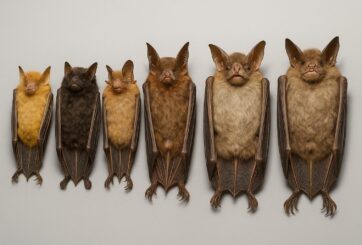
Just in time for Halloween, researchers from the Royal Ontario Museum (ROM), the Field Museum in Chicago, and Lawrence University in Wisconsin have announced the discovery of six new species of bats. These newly identified species, all found in the Philippines, belong to the group known as tube-nosed bats—a fascinating and diverse branch of the mammal family tree. Expanding the Tree of Life Formally recognized as new species through morphological and genetic analysis, this discovery expands the already impressive global…
In a recent study published today in the European Geosciences Union (EGU) journal Biogeosciences, scientists have confirmed that mercury pollution from artisanal and small-scale gold mining (ASGM) is contaminating food crops not through the soil, as previously believed, but directly from the air. Driven by the surging price of gold, which has increased by more than tenfold since 2000, the rapid expansion of unregulated mining in these regions raises urgent questions about food security, human health, and environmental justice The…
A new study from Iceland’s Surtsey island shows that birds carried most of the plants that colonised the island, challenging long-held beliefs that seed or fruit shape determines how plants spread — offering fresh insight into life’s adaptation to c When the volcanic island of Surtsey rose from the North Atlantic Ocean in 1963, it offered scientists a once-in-a-lifetime opportunity to observe how life takes hold on a brand-new and barren land. For decades, ecologists believed that plants’ ability to…
 Feedback
