



Feeding 9 Billion: Innovations in Agricultural Modeling
The African continent is slowly being pulled apart and new data collected by University of Leeds and Royal Holloway, University of London researchers suggests that molten rock from deep within the Earth is helping the rifting. Their findings, which help explain how continents split apart, are published in Nature this week.
Ethiopia sits on a boundary where a tectonic plate is being split into two and over several million years a new ocean basin is forming. The movement of plates on the Earth’s surface alone does not provide enough force to cause the rift seen in Ethiopia. Measurements of sub-surface waves and geological information show that molten rock – magma – rising through the Earth’s outer layers is reducing the strength of the plate, enabling it to break apart.
Geophysicists led by University of Leeds Professor Michael Kendall studied seismic waves as they passed through the Earth’s upper mantle over a 16 month experiment in Ethiopia. As the waves hit different materials their properties change. The recorded wave patterns indicate the presence of thin sheet-like upwellings of molten rock.
Professor Kendall said: “This is the largest experiment of its kind ever done in Africa. It is revealing answers to long-standing mysteries about continental plates and how they split apart to form new ocean basins.’’
Royal Holloway co-author Professor Cindy Ebinger added: “Scientists have previously proposed that magma may play a significant role in weakening continental plates, but this is the first supporting evidence from an active rift zone.”
Professor Kendall said: “We have found the signature of the melting process throughout the plate. The analysis also confirms the importance of magmatism, not just plate stretching, in creating rifts.”




Earthquakes in the American state of Utah, the Soultz-sous-Forêts region of France or in the Dutch province of Groningen should not be able to occur even if the subsurface has been exploited for decades. This is because the shallow subsurface behaves in such a way that faults there become stronger as soon as they start moving. At least that is what geology textbooks teach us. And so, in theory, it should not be possible for earthquakes to occur. So why…
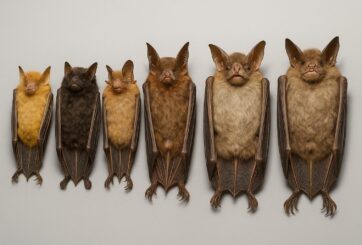
Just in time for Halloween, researchers from the Royal Ontario Museum (ROM), the Field Museum in Chicago, and Lawrence University in Wisconsin have announced the discovery of six new species of bats. These newly identified species, all found in the Philippines, belong to the group known as tube-nosed bats—a fascinating and diverse branch of the mammal family tree. Expanding the Tree of Life Formally recognized as new species through morphological and genetic analysis, this discovery expands the already impressive global…
In a recent study published today in the European Geosciences Union (EGU) journal Biogeosciences, scientists have confirmed that mercury pollution from artisanal and small-scale gold mining (ASGM) is contaminating food crops not through the soil, as previously believed, but directly from the air. Driven by the surging price of gold, which has increased by more than tenfold since 2000, the rapid expansion of unregulated mining in these regions raises urgent questions about food security, human health, and environmental justice The…
A new study from Iceland’s Surtsey island shows that birds carried most of the plants that colonised the island, challenging long-held beliefs that seed or fruit shape determines how plants spread — offering fresh insight into life’s adaptation to c When the volcanic island of Surtsey rose from the North Atlantic Ocean in 1963, it offered scientists a once-in-a-lifetime opportunity to observe how life takes hold on a brand-new and barren land. For decades, ecologists believed that plants’ ability to…
 Feedback
