



Feeding 9 Billion: Innovations in Agricultural Modeling
The humble tropical honeybee may challenge the idea that a post-asteroid impact “nuclear winter” was a big player in the decimation of dinosaurs 65 million years ago.
Somehow the tropical honeybee, Cretotrigona prisca, survived the end-Cretaceous extinction event, despite what many researchers believe was a years-long period of darkness and frigid temperatures caused by sunlight-blocking dust and smoke from the asteroid impact at Chicxulub.
The survival of C. prisca is problematic and telling, asserts paleontology graduate student Jacqueline M. Kozisek of the University of New Orleans. Late Cretaceous tropical honeybees preserved in amber are almost identical to their modern relatives, she says. If no modern tropical honeybee could have survived years in the dark and cold without the flowering plants they lived off of, Kozisek reasoned, something must be amiss with the nuclear winter theory. “It couldn’t have been that huge,” says Kozisek of the Chicxulub-related temperature drops asserted by other researchers.
Kozisek will present her work on Monday, 8 Nov., at the Geological Society of America annual meeting in Denver. Modern tropical honeybees have an optimal temperature range of 88 to 93 degrees F (31-34°C) in order to maintain vital metabolic activities, according to entomological research, says Kozisek. That’s also the range that’s best for their food source: nectar-rich flowering plants.
Based on what is known about the Cretaceous climate and modern tropical honeybees, Kozisek estimates that any post-impact winter event could not have dropped temperatures more than 4 to 13 degrees F (2-7°C) without wiping out the bees. Current nuclear winter theories from the Chicxulub impact estimate drops of 13 to 22 degrees F (7-12°C) – too cold for tropical honeybees. “I’m not trying to say an asteroid impact didn’t happen,” says Kozisek. “I’m just trying to narrow down the effects.”
To do this, Kozisek took a novel approach for a paleontologist – instead of looking at what died out, she dug through the literature to find out what survived the massive extinction event. “I made a list of all survivors and picked those with strict survival requirements,” said Kozisek. She determined that those survival requirements were by calling on studies of the closest modern analogues — which wasn’t always easy for some species, she pointed out. There was, for instance, a very early primate that crawled out of the Cretaceous alive, but there is really no comparable small primate around today with which to reliably compare, she said.
On the other hand, a good number of tropical honeybees haven’t changed a lot in 65 million years and a great deal is known about modern tropical honey bees’ tolerances to heat and cold. What’s more, amber-preserved specimens of the oldest tropical honey bee, Cretotrigona prisca, are almost indistinguishable from – and are probably the ancestors of – some modern tropical honeybees like Dactylurina, according to other studies cited by Kozisek.
Survival and Its Implications: Tropical Honeybees (Hymenoptera: Apidae: Meliponini) and the Cretaceous-Tertiary Boundary Monday, 8 November, 10:30-10:45 a.m., CCC 605 Abstract may be viewed at: http://gsa.confex.com/gsa/2004AM/finalprogram/abstract_80171.htm.




Earthquakes in the American state of Utah, the Soultz-sous-Forêts region of France or in the Dutch province of Groningen should not be able to occur even if the subsurface has been exploited for decades. This is because the shallow subsurface behaves in such a way that faults there become stronger as soon as they start moving. At least that is what geology textbooks teach us. And so, in theory, it should not be possible for earthquakes to occur. So why…
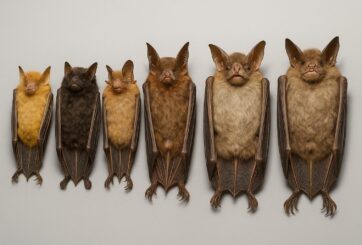
Just in time for Halloween, researchers from the Royal Ontario Museum (ROM), the Field Museum in Chicago, and Lawrence University in Wisconsin have announced the discovery of six new species of bats. These newly identified species, all found in the Philippines, belong to the group known as tube-nosed bats—a fascinating and diverse branch of the mammal family tree. Expanding the Tree of Life Formally recognized as new species through morphological and genetic analysis, this discovery expands the already impressive global…
In a recent study published today in the European Geosciences Union (EGU) journal Biogeosciences, scientists have confirmed that mercury pollution from artisanal and small-scale gold mining (ASGM) is contaminating food crops not through the soil, as previously believed, but directly from the air. Driven by the surging price of gold, which has increased by more than tenfold since 2000, the rapid expansion of unregulated mining in these regions raises urgent questions about food security, human health, and environmental justice The…
A new study from Iceland’s Surtsey island shows that birds carried most of the plants that colonised the island, challenging long-held beliefs that seed or fruit shape determines how plants spread — offering fresh insight into life’s adaptation to c When the volcanic island of Surtsey rose from the North Atlantic Ocean in 1963, it offered scientists a once-in-a-lifetime opportunity to observe how life takes hold on a brand-new and barren land. For decades, ecologists believed that plants’ ability to…
 Feedback
