



Feeding 9 Billion: Innovations in Agricultural Modeling
The longest animal that ever lived just got 40 percent shorter. A reappraisal of Seismosaurus has chopped it from 170 feet – about the length of ten hummers – to about 110 feet – a bit more than six hummers. The new look at the lengthiest beast also suggests it might also be a very close relative of a more common type of dino –Diplodocus.
Though drastically shorter, the new length estimate does not necessarily knock Seismosaurus off the throne as the Earth’s longest creature, says paleontologist Spencer Lucas of the New Mexico Museum of Natural History and Science. On the other hand, it does bring Seismosaurus within the range of the lengthiest living animal – the blue whale, which runs about 100 feet. A poster explaining how Lucas and his team arrived at the new measure of the longest animal will be presented on Tuesday afternoon, 9 Nov., at the annual meeting of the Geological Society of America in Denver. “The bottom line is it’s very, very hard to estimate length of dinosaurs from isolated bones,” says Lucas. “These estimates are not ideal.”
The key to resizing Seismosaurus, he says, was knowing where to place tail vertebrae of the incomplete, lone known specimen. Earlier researchers decided the tail, or caudal, vertebrae belonged far down the tail, meaning that to taper to an end after these vertebrae, the dino’s tail had to trail on for a good distance more.
To figure out if the initial placement of the caudal vertebrae was correct, Lucas and his colleagues scaled up a smaller, similar Diplodocus dinosaur to compare its caudal vertebrae. What they discovered was that instead of placing the caudal vertebrae as numbers 20 through 27 on the tail, they fit better higher up the tail as numbers 12 through 19. That was enough to shorten the estimated length of the animal by about 60 feet. “The more defensible estimate is 33 meters (110 feet),” Lucas concluded. The comparison to Diplodocus has also raised the possibility that Seismosaurus doesn’t really belongs in its own genus. It’s arguable, Lucas says, that Seismosaurus is just a big new species of Diplodocus. If so, it could get a scientific name change from Seismosaurus hallorum to Diplodocus hallorum. The more earthshaking name “Seismosaur” would likely endure, however, as sort of a “stage name,” says Lucas.
The new, revised Seismosaurus length is already incorporated into the Age of Giants exhibit which opened in August at the New Mexico Museum of Natural History and Science. In fact it was because of plans for the exhibit that Lucas and his colleagues decided to recheck the length of Seismosaurus, he said. All that is known about Seismosaurus comes from fossilized bones from the hip and part of the back of a single skeleton found in ancient riverbank deposits near San Ysidro, New Mexico in 1979. It was plain before the fossilized bones were extracted from the ground that this was an exceptionally large animal – even for a dinosaur.
The actual fossil remains of Seismosaurus are now on public display at the New Mexico Museum of Natural History and Science in Albuquerque.
Reappraisal of Seismosaurus, A Late Jurassic
Sauropod Dinosaur From New Mexico
Tuesday, November 9, 1:30 p.m.-5:30 p.m.
CCC Exhibit Hall
Abstract may be viewed at: http://gsa.confex.com/gsa/2004AM/finalprogram/abstract_77727.htm.
CONTACT INFORMATION
During the GSA Annual Meeting, 7-10 November, contact Ann Cairns at the GSA Newsroom, Colorado Convention Center, Denver, for assistance and to arrange for interviews: 303-228-8570.
Geological Society of America
116th Annual Meeting
7-10 November 2004
Colorado Convention Center




Earthquakes in the American state of Utah, the Soultz-sous-Forêts region of France or in the Dutch province of Groningen should not be able to occur even if the subsurface has been exploited for decades. This is because the shallow subsurface behaves in such a way that faults there become stronger as soon as they start moving. At least that is what geology textbooks teach us. And so, in theory, it should not be possible for earthquakes to occur. So why…
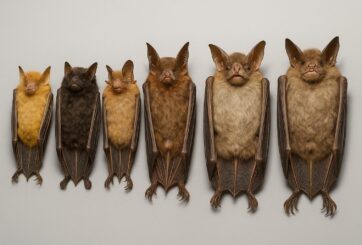
Just in time for Halloween, researchers from the Royal Ontario Museum (ROM), the Field Museum in Chicago, and Lawrence University in Wisconsin have announced the discovery of six new species of bats. These newly identified species, all found in the Philippines, belong to the group known as tube-nosed bats—a fascinating and diverse branch of the mammal family tree. Expanding the Tree of Life Formally recognized as new species through morphological and genetic analysis, this discovery expands the already impressive global…
In a recent study published today in the European Geosciences Union (EGU) journal Biogeosciences, scientists have confirmed that mercury pollution from artisanal and small-scale gold mining (ASGM) is contaminating food crops not through the soil, as previously believed, but directly from the air. Driven by the surging price of gold, which has increased by more than tenfold since 2000, the rapid expansion of unregulated mining in these regions raises urgent questions about food security, human health, and environmental justice The…
A new study from Iceland’s Surtsey island shows that birds carried most of the plants that colonised the island, challenging long-held beliefs that seed or fruit shape determines how plants spread — offering fresh insight into life’s adaptation to c When the volcanic island of Surtsey rose from the North Atlantic Ocean in 1963, it offered scientists a once-in-a-lifetime opportunity to observe how life takes hold on a brand-new and barren land. For decades, ecologists believed that plants’ ability to…
 Feedback
