



Feeding 9 Billion: Innovations in Agricultural Modeling
The biggest mass extinction of all time happened 251 million years ago, at the Permian-Triassic boundary. Virtually all of life was wiped out, but the pattern of how life was killed off on land has been mysterious until now. A team from Bristol University and Saratov University, Russia, have now laid the evidence bare.
The Bristol and Russian researchers have documented the event in Russia after looking at 675 specimens of amphibians and reptiles from 289 areas spanning 13 successive geological time zones in the South Urals basin. The study will be reported in Nature, Thursday, November 4.
The mass extinction at the Permian-Triassic boundary is accepted as the most profound loss of life on record. Records indicate a loss of 50 per cent of animal groups or more, in both sea and on land, with a loss of 80 to 96 per cent of species. Local and regional-scale studies of marine specimen confirm the loss, but the terrestrial record has been harder to analyse in such close detail.
There was a profound loss of animal groups, and simplification of ecosystems, with the loss of small fish eaters and insect eaters, medium and large herbivores and large carnivores. Plant life also changed, from high rates of turnover through the Late Permian period to greater stability at low diversity through the Early Triassic period. Even after 15 million years of ecosystem rebuilding, some groups were still absent–small fish eaters, small insect eaters, large herbivores and top carnivores.
The end-Permian mass extinction is now thought to have been caused by gigantic volcanic eruptions, which triggered a runaway greenhouse effect and nearly put an end to life on earth.
Mike Benton, Professor of Vertebrate Palaeontology and Head of the Department of Earth Sciences at Bristol University, said: “At the end of the Permian there was a high turnover in animal families on land however these were largely destroyed by the Permian-Triassic extinction. However, after that the animal groups recovered slowly and diversity gradually increased.”




Earthquakes in the American state of Utah, the Soultz-sous-Forêts region of France or in the Dutch province of Groningen should not be able to occur even if the subsurface has been exploited for decades. This is because the shallow subsurface behaves in such a way that faults there become stronger as soon as they start moving. At least that is what geology textbooks teach us. And so, in theory, it should not be possible for earthquakes to occur. So why…
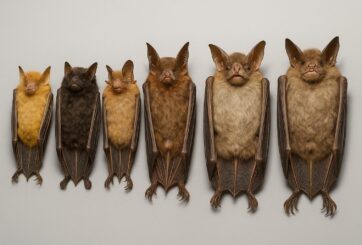
Just in time for Halloween, researchers from the Royal Ontario Museum (ROM), the Field Museum in Chicago, and Lawrence University in Wisconsin have announced the discovery of six new species of bats. These newly identified species, all found in the Philippines, belong to the group known as tube-nosed bats—a fascinating and diverse branch of the mammal family tree. Expanding the Tree of Life Formally recognized as new species through morphological and genetic analysis, this discovery expands the already impressive global…
In a recent study published today in the European Geosciences Union (EGU) journal Biogeosciences, scientists have confirmed that mercury pollution from artisanal and small-scale gold mining (ASGM) is contaminating food crops not through the soil, as previously believed, but directly from the air. Driven by the surging price of gold, which has increased by more than tenfold since 2000, the rapid expansion of unregulated mining in these regions raises urgent questions about food security, human health, and environmental justice The…
A new study from Iceland’s Surtsey island shows that birds carried most of the plants that colonised the island, challenging long-held beliefs that seed or fruit shape determines how plants spread — offering fresh insight into life’s adaptation to c When the volcanic island of Surtsey rose from the North Atlantic Ocean in 1963, it offered scientists a once-in-a-lifetime opportunity to observe how life takes hold on a brand-new and barren land. For decades, ecologists believed that plants’ ability to…
 Feedback
