



Feeding 9 Billion: Innovations in Agricultural Modeling
Yesterday, an important milestone was reached in the development of ESA’s GOCE (Gravity field and steady-state Ocean Circulation Explorer) mission, when a contract, worth €7.8 million, was signed between ESA and the Institute for Astronomical and Physical Geodesy (IAPG) from the Technical University of Munich.
The contract means that the scientific data resulting from the GOCE mission will be analysed by a consortium of 10 European universities and research institutes led by the IAPG. The consortium will then use the data to produce an unprecedented high-accuracy and high spatial-resolution global model of the Earth’s gravity field and of the geoid. Scientists from Switzerland, Germany, Denmark, the Netherlands, Austria, Italy and France will all cooperate in this project. The work will be managed by IAPG as prime contractor with the help of the National Institute of Space Research in the Netherlands (SRON).
The ceremony took place at the Technical University in Munich, Germany on 26 October when the contract was signed by Prof. Wolfgang Herrmann the President of the Technical University of Munich and Dr. Volker Liebig ESA’s Director of Earth Observation. Subsequently, all the project partners signed their contracts with the prime contractor.
GOCE, due for launch in 2006, is the first Earth Explorer Core mission to be developed as part of ESA’s Living Planet Programme. This mission, entirely dedicated to the exploration of the Earth’s gravity field, will significantly advance our knowledge in areas of solid-Earth physics, geodesy, oceanography as well as climate-change research.
The primary instrument is the newly developed gravity gradiometer. In order to attain the required sensitivity it is combined with precise GPS tracking, and active drag-free control of the spacecraft. Because the gravitational signal is stronger closer to the Earth, GOCE has been designed to fly in a particularly low orbit – at an altitude of just 250 km. The satellite has no mechanical moving parts since it has to be completely stable and rigid to ensure the acquisition of true gravity readings.
The signing of the contract for the ’GOCE High-Level Processing Facility’ ensures that the data acquired by the mission will be expertly translated into valuable information that will further our understanding of the planet.




Earthquakes in the American state of Utah, the Soultz-sous-Forêts region of France or in the Dutch province of Groningen should not be able to occur even if the subsurface has been exploited for decades. This is because the shallow subsurface behaves in such a way that faults there become stronger as soon as they start moving. At least that is what geology textbooks teach us. And so, in theory, it should not be possible for earthquakes to occur. So why…
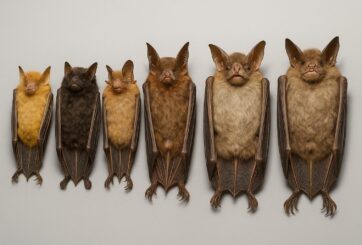
Just in time for Halloween, researchers from the Royal Ontario Museum (ROM), the Field Museum in Chicago, and Lawrence University in Wisconsin have announced the discovery of six new species of bats. These newly identified species, all found in the Philippines, belong to the group known as tube-nosed bats—a fascinating and diverse branch of the mammal family tree. Expanding the Tree of Life Formally recognized as new species through morphological and genetic analysis, this discovery expands the already impressive global…
In a recent study published today in the European Geosciences Union (EGU) journal Biogeosciences, scientists have confirmed that mercury pollution from artisanal and small-scale gold mining (ASGM) is contaminating food crops not through the soil, as previously believed, but directly from the air. Driven by the surging price of gold, which has increased by more than tenfold since 2000, the rapid expansion of unregulated mining in these regions raises urgent questions about food security, human health, and environmental justice The…
A new study from Iceland’s Surtsey island shows that birds carried most of the plants that colonised the island, challenging long-held beliefs that seed or fruit shape determines how plants spread — offering fresh insight into life’s adaptation to c When the volcanic island of Surtsey rose from the North Atlantic Ocean in 1963, it offered scientists a once-in-a-lifetime opportunity to observe how life takes hold on a brand-new and barren land. For decades, ecologists believed that plants’ ability to…
 Feedback
