



Feeding 9 Billion: Innovations in Agricultural Modeling
The intergovernmental Group on Earth Observations (GEO) met this week to agree important elements of a groundbreaking 10-year Plan that will pave the way toward building a global Earth Observation System. Over the next decade, this system will revolutionize our understanding of the Earth and how it works. With benefits as broad as the planet itself, this initiative promises to make peoples and economies around the globe healthier, safer and better equipped to manage basic daily needs. The aim is to create an observing system as interrelated as the planet it observes, predicts and protects – providing the science on which sound policy and decision-making can be built. The 10-Year Plan is set to be adopted at the 3rd Earth Observation Summit in Brussels next February – the highlight in a nine-day public “Earth & Space Week” devoted to raising awareness of the important role that Earth observation & space play in our society.
“The self-interest for the global community is clear,” said Achilleas Mitsos, Director-General for Research at the European Commission, and one of the four Co-Chairs of the GEO, “We are talking about nothing less than the future prosperity and security of the citizens of our world, so we must build in the following months a robust, workable and sustainable plan for the next decade. The European initiative on Global Monitoring for Environment and Security (GMES) will form an important contribution.”
The devil’s in the detail
In the run up to the Third Earth Observation Summit, the GEO convened for a special session on 27-28 September in Brussels to discuss and finalise key aspects related to the issue of governance and the 10-Year Plan. As with most international agreements, a successful consensus on the issue of how the Plan will be governed is critical to it being carried out successfully by all parties. The GEO plans to meet again in late November in Ottawa, Canada to finalise the Plan actions.
Earth & Space Week Announced
On the occasion of the GEO special session, Mitsos, in his role as one of the four GEO Co-chairs, officially announced that the European Commission with the collaboration of the European Space Agency (ESA) will host the first “Earth & Space Week” from 12-20 February 2005 in Brussels. Earth & Space Week will feature a broad spectrum of activities – from ministerial-level events like the Summit and an International Conference on Cooperation in Space to a major public Earth & Space Exposition. The week is designed to stimulate an awareness, understanding and appreciation of how Earth observation and Space initiatives help to improve the quality of life on our planet.




Earthquakes in the American state of Utah, the Soultz-sous-Forêts region of France or in the Dutch province of Groningen should not be able to occur even if the subsurface has been exploited for decades. This is because the shallow subsurface behaves in such a way that faults there become stronger as soon as they start moving. At least that is what geology textbooks teach us. And so, in theory, it should not be possible for earthquakes to occur. So why…
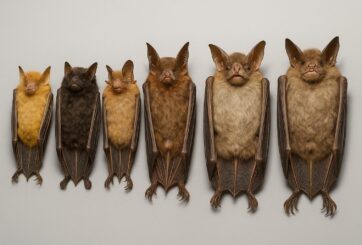
Just in time for Halloween, researchers from the Royal Ontario Museum (ROM), the Field Museum in Chicago, and Lawrence University in Wisconsin have announced the discovery of six new species of bats. These newly identified species, all found in the Philippines, belong to the group known as tube-nosed bats—a fascinating and diverse branch of the mammal family tree. Expanding the Tree of Life Formally recognized as new species through morphological and genetic analysis, this discovery expands the already impressive global…
In a recent study published today in the European Geosciences Union (EGU) journal Biogeosciences, scientists have confirmed that mercury pollution from artisanal and small-scale gold mining (ASGM) is contaminating food crops not through the soil, as previously believed, but directly from the air. Driven by the surging price of gold, which has increased by more than tenfold since 2000, the rapid expansion of unregulated mining in these regions raises urgent questions about food security, human health, and environmental justice The…
A new study from Iceland’s Surtsey island shows that birds carried most of the plants that colonised the island, challenging long-held beliefs that seed or fruit shape determines how plants spread — offering fresh insight into life’s adaptation to c When the volcanic island of Surtsey rose from the North Atlantic Ocean in 1963, it offered scientists a once-in-a-lifetime opportunity to observe how life takes hold on a brand-new and barren land. For decades, ecologists believed that plants’ ability to…
 Feedback
