



Feeding 9 Billion: Innovations in Agricultural Modeling
Researchers at the Faculty of Aerospace Engineering of TU Delft have succeeded in modelling the rotational behaviour of two satellites with unprecedented accuracy. This makes it possible to model the orbit of the satellites much more accurately and this means that changes on earth observed by the satellite are also more accurate, for example, melting of the polar icecaps or the transport of water and atmospheric mass around the globe.
Satellites often have a rotational movement after being launched. This rotation and the mechanical characteristics of the satellites influence their orbits. This phenomenon was previously described using a number of (incidental) measurements and a rough model. The model created by the Delft PhD Student Nacho Andrés and his supervisor Ron Noomen, together with colleagues from the United States, Italy and Japan, removes much uncertainty about the behaviour of satellites.
The rotational movement of satellites varies in time, from rapid movement, to almost none at all. Both situations have very different consequences for the temperature distribution on the satellite’s surface, and therefore on the size and direction of the so-called thermal forces that result from non-uniform heat radiation. These thermal forces are incredibly small, a factor 1013 smaller than the gravity that governs our everyday lives. Still, being able to calculate these small forces is important in the calculation of a satellite’s orbit.
The model that the researchers of the department of Earth Observation and Space Systems together with their international colleagues have developed, represents the orbital behaviour of the LAGEOS-1 and LAGEOS-2 satellites (launched in 1976 and 1992 respectively) with extreme accuracy (up to 1 cm). The model, called LOSSAM (LAGEOS Spin Axis Model), is based on independent observations of the rotation of satellites. It computes a whole range of forces that act on the satellites. LOSSAM provides an accuracy improvement of up to 50% over previous models. The new model is especially relevant for the rotational behaviour of LAGEOS-1 since 1998, because here, other models fail to produce results.
The research results have been published in a recent edition of the scientific Journal of Geophysical Research. In a follow-up project, the thermal and conductive characteristics of the satellites will be included, allowing a comprehensive thermal model to be constructed. This will, of course, further increase the accuracy of the model and therefore the satellites’ readings.




Earthquakes in the American state of Utah, the Soultz-sous-Forêts region of France or in the Dutch province of Groningen should not be able to occur even if the subsurface has been exploited for decades. This is because the shallow subsurface behaves in such a way that faults there become stronger as soon as they start moving. At least that is what geology textbooks teach us. And so, in theory, it should not be possible for earthquakes to occur. So why…
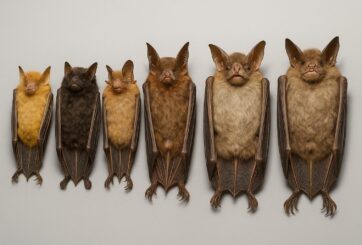
Just in time for Halloween, researchers from the Royal Ontario Museum (ROM), the Field Museum in Chicago, and Lawrence University in Wisconsin have announced the discovery of six new species of bats. These newly identified species, all found in the Philippines, belong to the group known as tube-nosed bats—a fascinating and diverse branch of the mammal family tree. Expanding the Tree of Life Formally recognized as new species through morphological and genetic analysis, this discovery expands the already impressive global…
In a recent study published today in the European Geosciences Union (EGU) journal Biogeosciences, scientists have confirmed that mercury pollution from artisanal and small-scale gold mining (ASGM) is contaminating food crops not through the soil, as previously believed, but directly from the air. Driven by the surging price of gold, which has increased by more than tenfold since 2000, the rapid expansion of unregulated mining in these regions raises urgent questions about food security, human health, and environmental justice The…
A new study from Iceland’s Surtsey island shows that birds carried most of the plants that colonised the island, challenging long-held beliefs that seed or fruit shape determines how plants spread — offering fresh insight into life’s adaptation to c When the volcanic island of Surtsey rose from the North Atlantic Ocean in 1963, it offered scientists a once-in-a-lifetime opportunity to observe how life takes hold on a brand-new and barren land. For decades, ecologists believed that plants’ ability to…
 Feedback
