



Feeding 9 Billion: Innovations in Agricultural Modeling
People in Georgia’s Dodge and Bleckley counties have for years picked up small pieces of natural glass called “Georgiaites,” which were produced by an unknown asteroid or comet impact millions of years ago. Just where these small, translucent green objects came from, however, was unclear.
Now researchers at the University of Georgia, studying a kaolin mine in Warren County, have found a layer of tiny grains, which indicate that the grains and the Georgiaites were products of a recently discovered impact that left a huge crater beneath the waters of the Chesapeake Bay. “We knew we had these tektites here, but we’d never found them in place,” said Michael Roden, a geologist and part of the research team. “We believe this layer is further evidence that the Chesapeake Bay impact was an enormous event with widespread consequences.”
The research was published in the August issue of the journal Geology.
The work was spearheaded by UGA graduate student Scott Harris (now with Brown University) in collaboration with Roden, Paul Schroeder and Steven Holland of UGA, Ed Albin of Fernbank and Mack Duncan of J.M. Huber Corporation.
Tektites are brown to green glassy objects, generally small and rounded, and thought to be of extraterrestrial origin. The only other state in the United States where tektites have been found in abundance is Texas. Some 1,700 have been found in Georgia to date, and potassium-argon geochronology has dated them to around 35 million years of age.
The Chesapeake Bay impact crater was only discovered about a decade ago, but before the current discovery, there was no known deposition layer from it extant, and it was unclear whether Georgiaites were the result of the cataclysmic collision of the Chesapeake Bay bolide with the Earth. (“Bolide” is a generic term for an impacting body.)
The now-unused kaolin mine in Warren County where the discovery was made was near the sea’s edge in ancient times. This former shore, now across the central part of Georgia, is more or less coincident with the Fall Line, and marks the place where ancient seas lapped the land. The impact in the Chesapeake Bay clearly caused a huge amount of material, both from the Earth and the asteroid, to become airborne, and the layer — discovered at a depth of 25 feet in the kaolin mine — was probably laid down by the event.
It was an active time: In the period between 34 million and 37 million years ago, at least five comets and/or asteroids collided with the Earth. Since some of the events may have caused climate alterations and caused at least regional disruptions of ecosystems, knowing more about the ejecta from the impacts is important.
The layer reported in Geology is perhaps the most easily accessible, undisturbed layer of materials that probably came from the Chesapeake Bay impact and can therefore add knowledge about that event. The search for the layer, led by Harris, led to the discovery of so-called shocked quartz — grains whose physical “thumbprint” mark them as having originated from the extremely high pressures characteristic of an impact event.
Just how big the explosion was when this celestial visitor hit the Earth is unclear, but Roden said it was many times bigger than such events as the explosions of Mt. St. Helen’s or even Krakatoa.




Earthquakes in the American state of Utah, the Soultz-sous-Forêts region of France or in the Dutch province of Groningen should not be able to occur even if the subsurface has been exploited for decades. This is because the shallow subsurface behaves in such a way that faults there become stronger as soon as they start moving. At least that is what geology textbooks teach us. And so, in theory, it should not be possible for earthquakes to occur. So why…
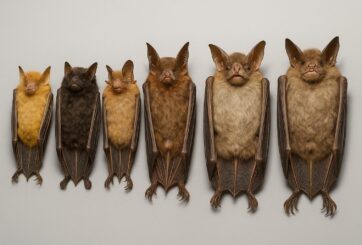
Just in time for Halloween, researchers from the Royal Ontario Museum (ROM), the Field Museum in Chicago, and Lawrence University in Wisconsin have announced the discovery of six new species of bats. These newly identified species, all found in the Philippines, belong to the group known as tube-nosed bats—a fascinating and diverse branch of the mammal family tree. Expanding the Tree of Life Formally recognized as new species through morphological and genetic analysis, this discovery expands the already impressive global…
In a recent study published today in the European Geosciences Union (EGU) journal Biogeosciences, scientists have confirmed that mercury pollution from artisanal and small-scale gold mining (ASGM) is contaminating food crops not through the soil, as previously believed, but directly from the air. Driven by the surging price of gold, which has increased by more than tenfold since 2000, the rapid expansion of unregulated mining in these regions raises urgent questions about food security, human health, and environmental justice The…
A new study from Iceland’s Surtsey island shows that birds carried most of the plants that colonised the island, challenging long-held beliefs that seed or fruit shape determines how plants spread — offering fresh insight into life’s adaptation to c When the volcanic island of Surtsey rose from the North Atlantic Ocean in 1963, it offered scientists a once-in-a-lifetime opportunity to observe how life takes hold on a brand-new and barren land. For decades, ecologists believed that plants’ ability to…
 Feedback
