



Feeding 9 Billion: Innovations in Agricultural Modeling
A billion years ago (the Neoproterozoic age), complex single-celled organisms, the acritarchs, began to develop, grow, and thrive. Almost a billion years later, the study of the evolutionary history of acritarchs began to bog down amid inconsistencies in the reporting of the diversity of species. Now, a Virginia Tech graduate student has devised a new way to study the ebb and flow of life in the Neoproterozoic and Early Cambrian ages, a period that includes two mass extinctions.
John Warren Huntley of Asheville, N.C., a PhD. student in geosciences, will report on his strategy and results at the joint meeting of the Northeastern and Southeastern Sections of the Geological Society of America, to be held March 25-27 in Tysons Corner, Va.
“The evolutionary history of acritarchs reported in the literature has been based on the number of species,” explains Huntley. “But there have been many workers collecting information and there is variation among these researchers on what is considered a species. This variation among workers could alter our understanding of what actually happened.”
The strategy of a group of geoscientists at Virginia Tech is to use the quantitative data reported in the scientific literature to look at size and morphological complexity of specimens collected. So far, they have examined acritarch data spanning more than 700 million years – from 1270-million-year-old rocks deposited long before Neoproterozoic ice ages, to Early Cambrian successions rocks deposited during the explosive evolution of early animals.
“Our preliminary results seem to confirm previous anecdotal evidence,” says Huntley. “We’re finding that complexity increases through time, which is to be expected.” However, complexity leveled off. “It appears that morphological complexity may have remained steady at high values, even when species diversity was fluctuating greatly,” Huntley says.
As to size, there was a steady increase in size for at least 500 million years, until the Ediacaran extinction, after which acritarchs remained very small compared to their pre-Ediacaran extinction size. “There had been anecdotal observations of the size change, which we have now quantified,” Huntley says.
Huntley will present the paper, “Secular patterns in morphological disparity and body size of acritarchs through the Neoproterozoic and early Cambrian” (47-2) at 1:20 p.m. Friday, March 26, as part of the session on Pre-Cenozoic Paleontology in the Gunston A room at the Hilton McLean-Tysons Corner hotel. Co-authors are Virginia Tech geosciences professors Shuhai Xiao and Michal Kowalewski.
The trio began their study of acritarchs last October. “It is interesting to use novel techniques to study early life and this is a good opportunity to increase my knowledge in this important area, ” says Huntley, who has been studying mollusk evolution.
Huntley received his bachelor’s degree from Appalachian State University and his master’s degree from the University of North Carolina at Wilmington.
Contact for more information:
John Warren Huntley, 540-231-1913 or jhuntley@vt.edu
Michal Kowalewski (Huntley’s major professor) michalk@vt.edu 540-231-5951
Shuhai Xiao, xiao@vt.edu, 540-231-1366




Earthquakes in the American state of Utah, the Soultz-sous-Forêts region of France or in the Dutch province of Groningen should not be able to occur even if the subsurface has been exploited for decades. This is because the shallow subsurface behaves in such a way that faults there become stronger as soon as they start moving. At least that is what geology textbooks teach us. And so, in theory, it should not be possible for earthquakes to occur. So why…
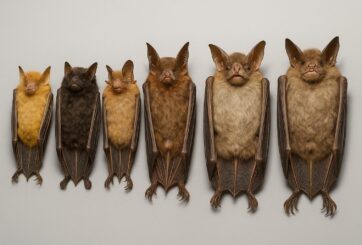
Just in time for Halloween, researchers from the Royal Ontario Museum (ROM), the Field Museum in Chicago, and Lawrence University in Wisconsin have announced the discovery of six new species of bats. These newly identified species, all found in the Philippines, belong to the group known as tube-nosed bats—a fascinating and diverse branch of the mammal family tree. Expanding the Tree of Life Formally recognized as new species through morphological and genetic analysis, this discovery expands the already impressive global…
In a recent study published today in the European Geosciences Union (EGU) journal Biogeosciences, scientists have confirmed that mercury pollution from artisanal and small-scale gold mining (ASGM) is contaminating food crops not through the soil, as previously believed, but directly from the air. Driven by the surging price of gold, which has increased by more than tenfold since 2000, the rapid expansion of unregulated mining in these regions raises urgent questions about food security, human health, and environmental justice The…
A new study from Iceland’s Surtsey island shows that birds carried most of the plants that colonised the island, challenging long-held beliefs that seed or fruit shape determines how plants spread — offering fresh insight into life’s adaptation to c When the volcanic island of Surtsey rose from the North Atlantic Ocean in 1963, it offered scientists a once-in-a-lifetime opportunity to observe how life takes hold on a brand-new and barren land. For decades, ecologists believed that plants’ ability to…
 Feedback
