



Feeding 9 Billion: Innovations in Agricultural Modeling
Institute of Physics Condensed Matter and Materials Physics Conference
University of Warwick, 4-7 April, 2004
Developments in predicting snow formation, snap-shot MRI (magnetic resonance imaging), organic semiconductor technology, high temperature superconductivity, and progress towards quantum computers are some of the topics being presented at a major conference organised by the Institute of Physics next month. The four-day conference, CMMP 2004, will take place from Sunday 4th to Wednesday 7th April 2004 at the University of Warwick.
Highlights include a presentation on Monday 5th April by Chris Westbrook and Professor Robin Ball from the University of Warwick who will be revealing progress towards developing a computer simulation of snowflake formation within clouds. The aim of the project – which is in collaboration with Dr Paul Field at the Met Office, who originally suggested the study – is to increase the accuracy of weather forecasting by allowing more information to be extracted from radar and satellite measurements of clouds.
When the temperature in a cloud is low enough, any water will usually form ice crystals. These can have many different shapes including rods with hexagonal sides and rosettes (which consist of three or more rods growing outwards from a central point), as well as the more familiar six-armed ice ’stars’. As the ice crystals move through clouds they bump into each other and stick together. Eventually the crystal clusters become so large that they are heavy enough to fall out of the cloud as ’snowflakes’ (where any individual snowflake will consist of a cluster of ice crystals of one particular shape). So far the Warwick team have investigated the clustering together of both rods and rosettes in cold, high altitude ice clouds known as cirrus clouds.
“We compute what would happen if you just randomly distribute these clusters in space then track what collisions will occur as they fall under gravity” explains Professor Ball. From these calculations, which assume the crystals stick together on contact, the Warwick team has obtained predictions of the shapes and the distribution of different sizes of ice clusters in cirrus clouds. These agree well with much of the experimental data obtained from various instruments including cloud particle imagers – special cameras which use a laser beam to illuminate the particles being photographed – by the National Center for Atmospheric Research in the USA.
The theoretical simulation does not however shed any light on why the ice crystals stick together. This process is occurring even at temperatures as low as -40ºC, where it is too cold for the accepted higher temperature method – of a thin liquid layer on the surface of the crystals freezing on contact and joining them together – to work. “We are already in a position to develop better interpretation of standard radar and satellite imaging techniques, but to firmly predict the size and concentration of ice crystal clusters – and hence reveal how intense the rain or snowfall will be – we need to know how the clustering starts. So we are now contemplating a direct attack on the question of what the sticking mechanism is” says Professor Ball, who acknowledges that modelling behaviour like this at a molecular level will be challenging due to the vast amounts of computing power needed.
There will be twenty-two symposia within the conference including ’Nanomagnetism and Spintronics’, ’Quantum Fluids and Solids’, ’Semiconductor Optics and Photonics’, ‘Applied Superconductivity’ and ’Bose-Einstein Condensates’. In addition to the presentations in each symposium, there will be a series of plenary lectures by world-renowned researchers. These include ‘Snap Shot MRI’ by Nobel prize-winner Sir Peter Mansfield, ‘Carbon Nanotube Electronics and Optoelectronics’ by P Avouris of IBM USA, ’Single Photon Devices for Quantum Cryptography’ by A Shields of Toshiba UK, ’Dynamic Phenomena in Magnets: Investigations over Five Orders of Magnitude’ by RL Stamps of the University of Western Australia and ’Liquids, Solids and Elastic Heresy in Between – is there a 2 1⁄2th State of Matter?’ by M Warner of the University of Cambridge, UK.




Earthquakes in the American state of Utah, the Soultz-sous-Forêts region of France or in the Dutch province of Groningen should not be able to occur even if the subsurface has been exploited for decades. This is because the shallow subsurface behaves in such a way that faults there become stronger as soon as they start moving. At least that is what geology textbooks teach us. And so, in theory, it should not be possible for earthquakes to occur. So why…
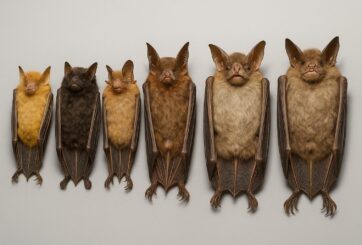
Just in time for Halloween, researchers from the Royal Ontario Museum (ROM), the Field Museum in Chicago, and Lawrence University in Wisconsin have announced the discovery of six new species of bats. These newly identified species, all found in the Philippines, belong to the group known as tube-nosed bats—a fascinating and diverse branch of the mammal family tree. Expanding the Tree of Life Formally recognized as new species through morphological and genetic analysis, this discovery expands the already impressive global…
In a recent study published today in the European Geosciences Union (EGU) journal Biogeosciences, scientists have confirmed that mercury pollution from artisanal and small-scale gold mining (ASGM) is contaminating food crops not through the soil, as previously believed, but directly from the air. Driven by the surging price of gold, which has increased by more than tenfold since 2000, the rapid expansion of unregulated mining in these regions raises urgent questions about food security, human health, and environmental justice The…
A new study from Iceland’s Surtsey island shows that birds carried most of the plants that colonised the island, challenging long-held beliefs that seed or fruit shape determines how plants spread — offering fresh insight into life’s adaptation to c When the volcanic island of Surtsey rose from the North Atlantic Ocean in 1963, it offered scientists a once-in-a-lifetime opportunity to observe how life takes hold on a brand-new and barren land. For decades, ecologists believed that plants’ ability to…
 Feedback
