



Feeding 9 Billion: Innovations in Agricultural Modeling
In the 19th century a fossil was uncovered in Belgium that was believed to be the jaw of a fish. Now a team of scientists have shown that it is in fact a fossil from an ancestor of all present-day land animals. It is the first discovery of a so-called tetrapod from the Devonian Period in continental Europe, which may trigger an interest in re-examining objects in museums.
In collaboration with researchers from France, England, and Belgium, Per Ahlberg, professor of evolutionary organism biology at Uppsala University, has demonstrated for the first time that four-legged fish, tetrapods, existed on the European continent during the Devonian Period (about 365 million years ago). These first land vertebrae became the ancestors of all present-day vertebrate amphibians, reptiles, birds, and mammals–and humans. The find also resembles the known “four-legged fish” Ichthyostega that was found by Swedish scientists in Greenland in the 1930s. Fossils of tetrapods from the Devonian Period are extremely rare. In recent years fragments have been found in the US, Scotland, Latvia, and China, among other places, but none of these bear any striking resemblance to Ichthyostega.
The fossil from Belgium is fragmentary (a portion of a lower jaw) but is interesting for several reasons:
Today we have considerably more detailed anatomical knowledge about the earliest tetrapods than 20 or 100 years ago, which makes it possible to identify them even from tiny fragments, such as portions of a lower jaw. In the past it would have been necessary to have at least the better part of a skull (or the rest of the skeleton) in order to recognize a tetrapod. Methods for extracting the fossil from its enclosing stone have also advanced substantially. A new and extremely interesting technique is CT scanning, entailing a series of “x-ray sections” through a fossil, thus visualizing its three-dimensional structure even while it is fully embedded in stone.




Earthquakes in the American state of Utah, the Soultz-sous-Forêts region of France or in the Dutch province of Groningen should not be able to occur even if the subsurface has been exploited for decades. This is because the shallow subsurface behaves in such a way that faults there become stronger as soon as they start moving. At least that is what geology textbooks teach us. And so, in theory, it should not be possible for earthquakes to occur. So why…
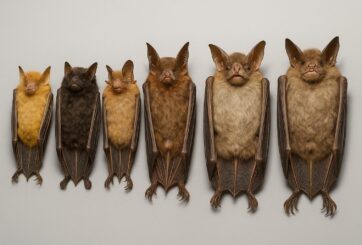
Just in time for Halloween, researchers from the Royal Ontario Museum (ROM), the Field Museum in Chicago, and Lawrence University in Wisconsin have announced the discovery of six new species of bats. These newly identified species, all found in the Philippines, belong to the group known as tube-nosed bats—a fascinating and diverse branch of the mammal family tree. Expanding the Tree of Life Formally recognized as new species through morphological and genetic analysis, this discovery expands the already impressive global…
In a recent study published today in the European Geosciences Union (EGU) journal Biogeosciences, scientists have confirmed that mercury pollution from artisanal and small-scale gold mining (ASGM) is contaminating food crops not through the soil, as previously believed, but directly from the air. Driven by the surging price of gold, which has increased by more than tenfold since 2000, the rapid expansion of unregulated mining in these regions raises urgent questions about food security, human health, and environmental justice The…
A new study from Iceland’s Surtsey island shows that birds carried most of the plants that colonised the island, challenging long-held beliefs that seed or fruit shape determines how plants spread — offering fresh insight into life’s adaptation to c When the volcanic island of Surtsey rose from the North Atlantic Ocean in 1963, it offered scientists a once-in-a-lifetime opportunity to observe how life takes hold on a brand-new and barren land. For decades, ecologists believed that plants’ ability to…
 Feedback
