



Feeding 9 Billion: Innovations in Agricultural Modeling
At the end of the Cretaceous, when large-sized theropods, such as Tyrannosaurus rex, roamed terrestrial environments, shallow seas and oceans were invaded by giant marine monitors – the mosasaurs. A recent investigation, presented in a new dissertation at Lund University in Sweden, has revealed that the Swedish mosasaur fauna is one of the most diverse assemblages known. Moreover, available data indicate that a major faunal turnover occurred about 80 million years ago.
The family Mosasauridae comprises large to giant (about 3-13 m long) reptiles that inhabited epicontinental seas and coastal areas, in a brief 25 million year period, during the later half of the Cretaceous (i.e. 90-65 million years ago). With their elongate bodies, massive jaws and powerful conical teeth, mosasaurs were probably the nearest equivalent to the mythical sea serpent that ever ruled the oceans. They swam by means of lateral undulations generated by the posterior portion of the elongated body and the deep, laterally compressed tail, while the flipper-shaped extremities were used as stabilisers for steering rather than for propulsion. Living as active predators at the top of the marine food chain, mosasaurs hunted in near-surface water with the help of a good sense of sight and sub-aqueous hearing. Several feeding strategies have been proposed as plausible, and many species exploited a wide range of food sources, including molluscs, fish and aquatic tetrapods.
Marine strata of Late Cretaceous age in southern Sweden have yielded a considerable number of isolated tooth-crowns, vertebrae and other, fragmentary skeletal remains of mosasaurs (in addition to fossils of dinosaurs, plesiosaurs, pterosaurs, sharks and sea turtles). Together with extensive mosasaur material (collected by quarrymen in connection with limestone quarrying in the early twentieth century) housed at various museums and departments in Sweden, these specimens demonstrate that the mosasaur assemblage of southern Sweden is one of the most diverse faunas known. The assemblage is similar in composition to approximately coeval mosasaur faunas from the Western Interior and the Gulf Coast of North America.
Available data suggest that the group increased steadily in diversity from the late Coniacian until near the early/late Campanian boundary (i.e. 90-80 million years ago), at which a seemingly catastrophic event, or a series of events, severely reduced the number of species in, at least, North America and Europe. The extinction favoured a radiation of more derived, although often less diverse, mosasaur taxa, which persisted until the end of the Maastrichtian stage, when the group suddenly and unexpectedly vanished.




Earthquakes in the American state of Utah, the Soultz-sous-Forêts region of France or in the Dutch province of Groningen should not be able to occur even if the subsurface has been exploited for decades. This is because the shallow subsurface behaves in such a way that faults there become stronger as soon as they start moving. At least that is what geology textbooks teach us. And so, in theory, it should not be possible for earthquakes to occur. So why…
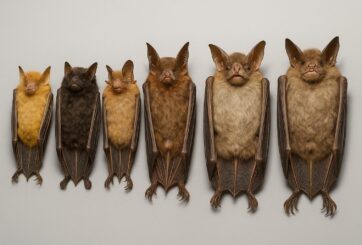
Just in time for Halloween, researchers from the Royal Ontario Museum (ROM), the Field Museum in Chicago, and Lawrence University in Wisconsin have announced the discovery of six new species of bats. These newly identified species, all found in the Philippines, belong to the group known as tube-nosed bats—a fascinating and diverse branch of the mammal family tree. Expanding the Tree of Life Formally recognized as new species through morphological and genetic analysis, this discovery expands the already impressive global…
In a recent study published today in the European Geosciences Union (EGU) journal Biogeosciences, scientists have confirmed that mercury pollution from artisanal and small-scale gold mining (ASGM) is contaminating food crops not through the soil, as previously believed, but directly from the air. Driven by the surging price of gold, which has increased by more than tenfold since 2000, the rapid expansion of unregulated mining in these regions raises urgent questions about food security, human health, and environmental justice The…
A new study from Iceland’s Surtsey island shows that birds carried most of the plants that colonised the island, challenging long-held beliefs that seed or fruit shape determines how plants spread — offering fresh insight into life’s adaptation to c When the volcanic island of Surtsey rose from the North Atlantic Ocean in 1963, it offered scientists a once-in-a-lifetime opportunity to observe how life takes hold on a brand-new and barren land. For decades, ecologists believed that plants’ ability to…
 Feedback
