



Feeding 9 Billion: Innovations in Agricultural Modeling
An international team of marine geologists has just completed an expedition to an area off the coast of Surinam known as the Demerara Rise. The scientists were part of the two-month Leg 207 of the NSF-supported Ocean Drilling Program (ODP) expedition in the equatorial Atlantic Ocean. The project studied periods in Earth’s history that have undergone rapid climate and ocean circulation changes and likely led to mass extinctions of plants and animals.
Three decades ago, geologists found sediments in the Demerara Rise from the Cretaceous Period (140-65 million years ago) that contained evidence of times when the equatorial Atlantic Ocean was without oxygen. These periods, known as “ocean anoxic events,” indicate that the oceans had a vastly different circulation pattern than they do today.
“Therefore, climate would have been significantly different. We don’t yet fully understand the reasons for these differences,” said Jochen Erbacher of the Federal Institute for Geosciences and Natural Resources in Germany. “Our objective [on this cruise] was to re-core the former site to understand past ocean circulation with respect to water depth change.”
Scientists also brought up sediment cores that show other periods of dramatic change in Earth’s history. In these sediments are well-preserved intervals of the Cretaceous/Tertiary boundary. At that time, some 65 million years ago, a huge asteroid or comet crashed into the Earth. Scientists believe the resulting cloud of debris may have blocked out sunlight, resulting in the extinction of plants and animals, including dinosaurs.
The Leg 207 team included sedimentologists, stratigraphers, paleontologists, geochemists, engineers, and geophysicists.
“It is only through the integration of all these disciplines that we can begin to understand the causes and effects of these periods of climatic and oceanographic change,” said scientist David Mosher of the Geological Survey of Canada. “With a better understanding of what happened in the past, we can perhaps know more about what the Earth is presently enduring,” he said.
Adds Paul Dauphin, program director for ODP at NSF, “The research team chose this area for the potentially high-resolution paleoceanographic records that could be recovered [in sediments] for the time intervals of interest, and for the important role that tropical regions play in driving ocean and atmospheric circulation.”
ODP is an international partnership of scientists and research institutions organized to study the evolution and structure of the Earth. It is funded principally by NSF, with substantial contributions from international partners.




Earthquakes in the American state of Utah, the Soultz-sous-Forêts region of France or in the Dutch province of Groningen should not be able to occur even if the subsurface has been exploited for decades. This is because the shallow subsurface behaves in such a way that faults there become stronger as soon as they start moving. At least that is what geology textbooks teach us. And so, in theory, it should not be possible for earthquakes to occur. So why…
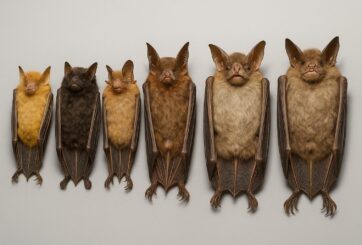
Just in time for Halloween, researchers from the Royal Ontario Museum (ROM), the Field Museum in Chicago, and Lawrence University in Wisconsin have announced the discovery of six new species of bats. These newly identified species, all found in the Philippines, belong to the group known as tube-nosed bats—a fascinating and diverse branch of the mammal family tree. Expanding the Tree of Life Formally recognized as new species through morphological and genetic analysis, this discovery expands the already impressive global…
In a recent study published today in the European Geosciences Union (EGU) journal Biogeosciences, scientists have confirmed that mercury pollution from artisanal and small-scale gold mining (ASGM) is contaminating food crops not through the soil, as previously believed, but directly from the air. Driven by the surging price of gold, which has increased by more than tenfold since 2000, the rapid expansion of unregulated mining in these regions raises urgent questions about food security, human health, and environmental justice The…
A new study from Iceland’s Surtsey island shows that birds carried most of the plants that colonised the island, challenging long-held beliefs that seed or fruit shape determines how plants spread — offering fresh insight into life’s adaptation to c When the volcanic island of Surtsey rose from the North Atlantic Ocean in 1963, it offered scientists a once-in-a-lifetime opportunity to observe how life takes hold on a brand-new and barren land. For decades, ecologists believed that plants’ ability to…
 Feedback
