



Feeding 9 Billion: Innovations in Agricultural Modeling
Powerful computer models predict that winter temperatures in the polar regions of the world could rise as much as 10 degrees centigrade in the next hundred years, if no efforts are made to control production of carbon dioxide, methane and other gasses.
“With projections to the year 2100, we can show what will happen if we continue with business as usual—if we don’t do anything to curb emissions of greenhouse gasses,” said Warren M. Washington, senior research scientist for the National Center for Atmospheric Research (NCAR) and a speaker at the AAAS Annual Meeting.
Noting that concentrations of carbon dioxide and methane did not start to increase significantly until the 20th century, Washington demonstrated with charts and graphs worldwide projections for average temperature in 2050 and 2090, and compared the data to the relatively stable temperature pattern in the 1000 years that preceded the growing presence of greenhouse gasses in the atmosphere.
“The greatest warming takes place in the winter hemisphere, and is strongly influenced by the retreat of snow and ice in high latitudes,” said Washington, who is also chairman of the National Science Board. “The range of (computer) models for global climate change at end of the century is 1.5 to 6 degrees centigrade, with most of the models in the range of 2-4 degrees. In the polar regions the changes of the order of 8 to more than 10 degrees in the winter time of the years.”
The computer predictions, produced by the NCAR Parallel Climate Model and by other computer systems, are made by interpreting data gathered on sea ice, land-vegetation, ocean and atmospheric components of the climate system, and creating an interactive system for understanding how they work together to influence the earth’s climate.
“The atmospheric, ocean and sea ice components make use of the fundamental laws of physics,” Washington said. “In the atmosphere, for example, equations describe the wind, temperature, density and pressure relationships. Climate models require supercomputer capability to solve the complex interactive mathematical equations.”
###
The American Association for the Advancement of Science (AAAS) is the world’s largest general scientific society, and publisher of the journal, Science. Founded in 1848, AAAS serves 134,000 members as well as 272 affiliates, representing 10 million scientists.




Earthquakes in the American state of Utah, the Soultz-sous-Forêts region of France or in the Dutch province of Groningen should not be able to occur even if the subsurface has been exploited for decades. This is because the shallow subsurface behaves in such a way that faults there become stronger as soon as they start moving. At least that is what geology textbooks teach us. And so, in theory, it should not be possible for earthquakes to occur. So why…
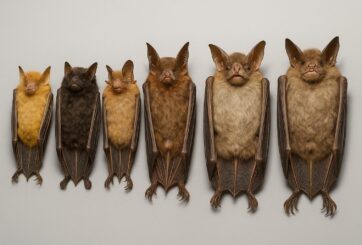
Just in time for Halloween, researchers from the Royal Ontario Museum (ROM), the Field Museum in Chicago, and Lawrence University in Wisconsin have announced the discovery of six new species of bats. These newly identified species, all found in the Philippines, belong to the group known as tube-nosed bats—a fascinating and diverse branch of the mammal family tree. Expanding the Tree of Life Formally recognized as new species through morphological and genetic analysis, this discovery expands the already impressive global…
In a recent study published today in the European Geosciences Union (EGU) journal Biogeosciences, scientists have confirmed that mercury pollution from artisanal and small-scale gold mining (ASGM) is contaminating food crops not through the soil, as previously believed, but directly from the air. Driven by the surging price of gold, which has increased by more than tenfold since 2000, the rapid expansion of unregulated mining in these regions raises urgent questions about food security, human health, and environmental justice The…
A new study from Iceland’s Surtsey island shows that birds carried most of the plants that colonised the island, challenging long-held beliefs that seed or fruit shape determines how plants spread — offering fresh insight into life’s adaptation to c When the volcanic island of Surtsey rose from the North Atlantic Ocean in 1963, it offered scientists a once-in-a-lifetime opportunity to observe how life takes hold on a brand-new and barren land. For decades, ecologists believed that plants’ ability to…
 Feedback
