



Feeding 9 Billion: Innovations in Agricultural Modeling
Sometimes getting too much of a good thing may create more problems than not getting enough – especially when it comes to the weather. Just ask Texas A&M University atmospheric scientist Fuqing Zhang, whose ensemble weather forecasting research is burdened with trillions of bytes of real-time data.
Zhang’s quest, funded by a National Science Foundation grant of $295,500, is to find the best way to assimilate the most recent weather observation data for input into the latest computer forecasting models.
“Right now, we have good computer programs to help us forecast tomorrow’s weather,” Zhang said. “For example, the official U.S. weather forecast, issued by the National Center for Environmental Protection (NCEP), part of the National Oceanographic and Atmospheric Agency (NOAA), is completely computer generated, untouched, as it were, by human hands.
“The problem is that we have overwhelming amounts of data to put into such models,” he continued. “We receive numbers on wind, water, temperature from surface weather stations, weather balloons, national Doppler radar coverage and satellites at rates that vary from minutes to hours to days. All this data is hard to integrate for computer input because it varies according to the different spatial, geographic and temporal scales over which it was collected. In addition, many of the measurements are indirect indicators of physical conditions.
“So, we need to come up with better ways to digest all this data in order to have immediate impacts on our daily weather predictions.”
Zhang and his team of collaborators from NOAA, the National Center for Atmospheric Research (NCAR) and the University of Washington (Seattle) are hoping to help forecasting computers’ data digestion processes through use of innovative statistical techniques permitting ensemble-based data assimilation.
“Ensemble-based data assimilation focuses on better ways to incorporate the uncertainties surrounding both yesterday’s forecast and today’s observations,” Zhang said. “We sample the ways in which the previous day’s forecast deviated from what really happened, and we sample the wealth of data available to us from the present 12 hour period. Then we use statistics to get the best estimate of current initial conditions for the computer forecasting models, which predict tomorrow’s weather.
“Even given the problems of data sampling and uncertainty, new generation numerical weather prediction via computer simulations significantly outperforms human forecasters,” he continued. “Now, innovative data assimilation techniques will not only take full advantage of current weather observations to make better daily weather forecasts, it will also provide guidance in designing next-generation weather observation networks.”




Earthquakes in the American state of Utah, the Soultz-sous-Forêts region of France or in the Dutch province of Groningen should not be able to occur even if the subsurface has been exploited for decades. This is because the shallow subsurface behaves in such a way that faults there become stronger as soon as they start moving. At least that is what geology textbooks teach us. And so, in theory, it should not be possible for earthquakes to occur. So why…
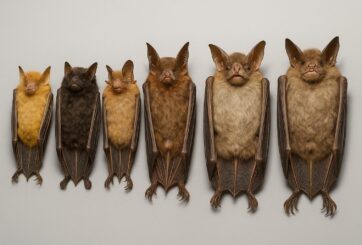
Just in time for Halloween, researchers from the Royal Ontario Museum (ROM), the Field Museum in Chicago, and Lawrence University in Wisconsin have announced the discovery of six new species of bats. These newly identified species, all found in the Philippines, belong to the group known as tube-nosed bats—a fascinating and diverse branch of the mammal family tree. Expanding the Tree of Life Formally recognized as new species through morphological and genetic analysis, this discovery expands the already impressive global…
In a recent study published today in the European Geosciences Union (EGU) journal Biogeosciences, scientists have confirmed that mercury pollution from artisanal and small-scale gold mining (ASGM) is contaminating food crops not through the soil, as previously believed, but directly from the air. Driven by the surging price of gold, which has increased by more than tenfold since 2000, the rapid expansion of unregulated mining in these regions raises urgent questions about food security, human health, and environmental justice The…
A new study from Iceland’s Surtsey island shows that birds carried most of the plants that colonised the island, challenging long-held beliefs that seed or fruit shape determines how plants spread — offering fresh insight into life’s adaptation to c When the volcanic island of Surtsey rose from the North Atlantic Ocean in 1963, it offered scientists a once-in-a-lifetime opportunity to observe how life takes hold on a brand-new and barren land. For decades, ecologists believed that plants’ ability to…
 Feedback
