



Feeding 9 Billion: Innovations in Agricultural Modeling
What will some 4,000 of the smartest dressed elephant seals, tuna fish, albatrosses, leatherback sea turtles, great white sharks, and other pelagic megafauna in the Pacific all be wearing in the coming seasons? How about the latest in microprocessor-based electronic tags, some no bigger than oversized cufflinks? It’s all in a continuing effort to understand the habits of marine animals in that part of the world: what exactly lives where and why, what their migration routes and diving behaviors might be, and what might be going on in the ocean all around them – temperature, salinity and other physical data.
It’s called the TOPP program – Tagging of the Pacific Pelagics – and it is funded as one of the six pilot projects currently funded as part of the Census of Marine Life (COML). It will be a 10-year-long undertaking over a vast part of the world’s oceans, funded by the Office of Naval Research in partnership with the Sloan and Packard Foundations.
In recent years, technology that allows us to examine the migrations of large oceanic animals (pop-up satellite archival tags, satellite-linked data recorders, archival and sonic tags) has proven enormously successful. Animal movements and behaviors can be linked to oceanographic processes by integrating biological and physical data providing both atmospheric and oceanographic information, and offering unprecedented insights into the relationship between physical ocean processes and top predators like tunas, dolphins, and sharks. Fifteen to twenty species of pelagic organisms from several trophic levels, many with similar patterns of spatial and temporal distributions, will be monitored throughout the North Pacific. Simultaneous tagging of the target marine species will permit the monitoring of their movement and behavior relative to environmental conditions. Results from TOPP will provide a framework for future management and conservation of these economically and ecologically valuable resources.
“To be able to electronically tag and track many individuals of several different species across immense areas of the ocean is a daunting task,” says ONR marine mammal expert Robert Gisiner. “But, this program is going to allow us to study the movements of these animals both spatially and temporally at resolutions previously unknown.”




Earthquakes in the American state of Utah, the Soultz-sous-Forêts region of France or in the Dutch province of Groningen should not be able to occur even if the subsurface has been exploited for decades. This is because the shallow subsurface behaves in such a way that faults there become stronger as soon as they start moving. At least that is what geology textbooks teach us. And so, in theory, it should not be possible for earthquakes to occur. So why…
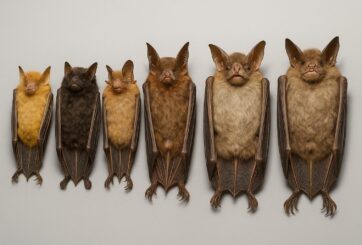
Just in time for Halloween, researchers from the Royal Ontario Museum (ROM), the Field Museum in Chicago, and Lawrence University in Wisconsin have announced the discovery of six new species of bats. These newly identified species, all found in the Philippines, belong to the group known as tube-nosed bats—a fascinating and diverse branch of the mammal family tree. Expanding the Tree of Life Formally recognized as new species through morphological and genetic analysis, this discovery expands the already impressive global…
In a recent study published today in the European Geosciences Union (EGU) journal Biogeosciences, scientists have confirmed that mercury pollution from artisanal and small-scale gold mining (ASGM) is contaminating food crops not through the soil, as previously believed, but directly from the air. Driven by the surging price of gold, which has increased by more than tenfold since 2000, the rapid expansion of unregulated mining in these regions raises urgent questions about food security, human health, and environmental justice The…
A new study from Iceland’s Surtsey island shows that birds carried most of the plants that colonised the island, challenging long-held beliefs that seed or fruit shape determines how plants spread — offering fresh insight into life’s adaptation to c When the volcanic island of Surtsey rose from the North Atlantic Ocean in 1963, it offered scientists a once-in-a-lifetime opportunity to observe how life takes hold on a brand-new and barren land. For decades, ecologists believed that plants’ ability to…
 Feedback
