



Feeding 9 Billion: Innovations in Agricultural Modeling
Working aboard research vessels in the Atlantic, scientists mapped the distribution of nutrients including phosphorous and nitrogen and investigated how organisms such as phytoplankton are sustained in areas with low nutrient levels.
They found that plants are able to grow in these regions because they are able to take advantage of iron minerals in Saharan dust storms. This allows them to use organic or ‘recycled’ material from dead or decaying plants when nutrients such as phosphorous – an essential component of DNA – in the ocean are low.
Professor George Wolff, from the University’s Department of Earth and Ocean Sciences, explains: “We found that cyanobacteria – a type of ancient phytoplankton – are significant to the understanding of how ocean deserts can support plant growth. Cyanobacteria need nitrogen, phosphorous and iron in order to grow. They get nitrogen from the atmosphere, but phosphorous is a highly reactive chemical that is scarce in sea water and is not found in the Earth’s atmosphere. Iron is present only in tiny amounts in sea water, even though it is one of the most abundant elements on earth.
“Our findings suggest that Saharan dust storms are largely responsible for the significant difference between the numbers of cyanobacteria in the North and South Atlantic. The dust fertilises the North Atlantic and allows phytoplankton to use organic phosphorous, but it doesn’t reach the southern regions and so without enough iron, phytoplankton are unable to use the organic material and don’t grow as successfully.”
Professor Ric Williams, co-author of the research, added: “The Atlantic is often referred to as an ‘ocean desert’ because many nutrients, which are essential in plant life cycles, are either scarce or are only accessible in the darker depths of the ocean. Plants, however, need some sunlight in order to absorb these important nutrients and so can’t always access them from the ocean depths. They therefore need to find the nutrients from elsewhere. Now that we are able to show how cyanobacteria make use of organic material we can understand more clearly how life is sustained in the ocean and why it isn’t an ‘ocean desert.’
“These findings are important because plant life cycles are essential in maintaining the balance of gases in our atmosphere. In looking at how plants survive in this area, we have shown how the Atlantic is able to draw down carbon dioxide from the atmosphere through the growth of photosynthesising plants.”




Earthquakes in the American state of Utah, the Soultz-sous-Forêts region of France or in the Dutch province of Groningen should not be able to occur even if the subsurface has been exploited for decades. This is because the shallow subsurface behaves in such a way that faults there become stronger as soon as they start moving. At least that is what geology textbooks teach us. And so, in theory, it should not be possible for earthquakes to occur. So why…
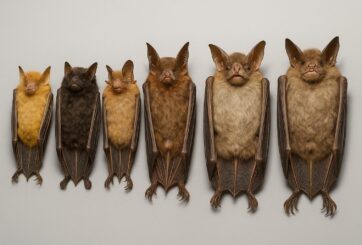
Just in time for Halloween, researchers from the Royal Ontario Museum (ROM), the Field Museum in Chicago, and Lawrence University in Wisconsin have announced the discovery of six new species of bats. These newly identified species, all found in the Philippines, belong to the group known as tube-nosed bats—a fascinating and diverse branch of the mammal family tree. Expanding the Tree of Life Formally recognized as new species through morphological and genetic analysis, this discovery expands the already impressive global…
In a recent study published today in the European Geosciences Union (EGU) journal Biogeosciences, scientists have confirmed that mercury pollution from artisanal and small-scale gold mining (ASGM) is contaminating food crops not through the soil, as previously believed, but directly from the air. Driven by the surging price of gold, which has increased by more than tenfold since 2000, the rapid expansion of unregulated mining in these regions raises urgent questions about food security, human health, and environmental justice The…
A new study from Iceland’s Surtsey island shows that birds carried most of the plants that colonised the island, challenging long-held beliefs that seed or fruit shape determines how plants spread — offering fresh insight into life’s adaptation to c When the volcanic island of Surtsey rose from the North Atlantic Ocean in 1963, it offered scientists a once-in-a-lifetime opportunity to observe how life takes hold on a brand-new and barren land. For decades, ecologists believed that plants’ ability to…
 Feedback
