



Feeding 9 Billion: Innovations in Agricultural Modeling
In an article published today in the journal Science, a group of former senior federal officials call for the establishment of an independent Earth Systems Science Agency (ESSA) to meet the unprecedented environmental and economic challenges facing the nation. They propose forming the new agency by merging the National Oceanic and Atmospheric Administration (NOAA) and the U.S. Geological Survey (USGS).
Charles Kennel, former Associate Administrator of the National Aeronautics and Space Administration and Director of Mission to Planet Earth, says, “Earth system science focuses on understanding current processes and predicting changes that will take place over the next hundred years. It merges earth, atmospheric, and ocean science into a panorama of the earth system as it is today and as it will be tomorrow. We need it to predict climate change and its impacts, and to help us mitigate and adapt to other changes that have the potential to affect our quality of life and economic well-being.”
The article entitled “An Earth Systems Science Agency,” points to the many scientific advantages of linking the atmospheric and marine programs of NOAA with the terrestrial, freshwater, and biological programs of USGS. Former NOAA administrator D. James Baker and former USGS director Charles Groat, among the seven coauthors of the paper, see important synergies in linking the two agencies.
According to Baker, “Population pressure, development impact, and resource extraction affect land and sea alike. Just as the science of the Earth is seamless, so should the government responsibility be merged for these separate Earth agencies.”
Groat points to the breadth of capabilities the agency would possess. “The USGS, in bringing not only its geologic, biologic, hydrologic and geospatial expertise to the understanding of natural systems, but also its research capabilities in energy, mineral, water, and biologic resources, gives the new organization a comprehensive perspective on both environmental and resource systems. If we effectively link these capabilities with those of NOAA, we will have a powerful research institution,” he says.
The authors express concern that federal environmental research, development, and monitoring programs are not presently structured to address such major environmental problems as global climate change, declines in freshwater availability and quality, and loss of biodiversity.
According to Donald Kennedy, former commissioner of the Food and Drug Administration and past president of Stanford University, “It isn't often that we are offered a real opportunity to make government work better. But the modest, sensible reorganization proposed here brings a new science-rich focus on some of our biggest contemporary challenges.”
Kennedy also stresses the importance of linking ESSA's activities with the tremendous talent in the nation's universities.
The authors recommend that no less than 25 percent of the new agency's budget be devoted to grants, contracts, and cooperative agreements with academic and nonprofit institutions.
ESSA's success will also hinge on the collaborative arrangements the agency makes with other federal departments and agencies. According to former presidential science adviser John H. Gibbons, “ESSA's effectiveness will depend upon the bridges it builds to other federal agencies, from the National Aeronautics and Space Administration and National Science Foundation, to the Department of Energy and U.S. Environmental Protection Agency.”
David Rejeski, who worked in both the White House Office of Science and Technology Policy and the Council on Environmental Quality, emphasizes the importance of setting aside some of ESSA's budget to fund research and development with breakthrough potential. “The Defense Advanced Research Projects Agency has demonstrated the value of funding high-risk, high-reward research and development. ESSA should foster similar ventures in the environmental arena,” Rejeski says.
The paper points to the direct link between research and development and economic growth. The work of NOAA and USGS already fuels a large, multi-billion dollar private sector enterprise.
Mark Schaefer, a former official at the Department of the Interior and the White House science office, adds that “the quality of life of future generations will be defined by the quality of the environment we hand down to them. Our nation's research and development enterprise must be better structured and directed if we are to have any chance of solving the tremendous environmental challenges of our time.”




Earthquakes in the American state of Utah, the Soultz-sous-Forêts region of France or in the Dutch province of Groningen should not be able to occur even if the subsurface has been exploited for decades. This is because the shallow subsurface behaves in such a way that faults there become stronger as soon as they start moving. At least that is what geology textbooks teach us. And so, in theory, it should not be possible for earthquakes to occur. So why…
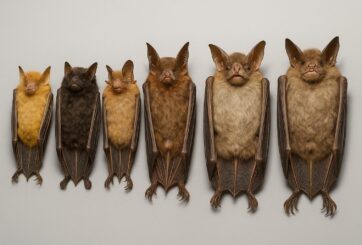
Just in time for Halloween, researchers from the Royal Ontario Museum (ROM), the Field Museum in Chicago, and Lawrence University in Wisconsin have announced the discovery of six new species of bats. These newly identified species, all found in the Philippines, belong to the group known as tube-nosed bats—a fascinating and diverse branch of the mammal family tree. Expanding the Tree of Life Formally recognized as new species through morphological and genetic analysis, this discovery expands the already impressive global…
In a recent study published today in the European Geosciences Union (EGU) journal Biogeosciences, scientists have confirmed that mercury pollution from artisanal and small-scale gold mining (ASGM) is contaminating food crops not through the soil, as previously believed, but directly from the air. Driven by the surging price of gold, which has increased by more than tenfold since 2000, the rapid expansion of unregulated mining in these regions raises urgent questions about food security, human health, and environmental justice The…
A new study from Iceland’s Surtsey island shows that birds carried most of the plants that colonised the island, challenging long-held beliefs that seed or fruit shape determines how plants spread — offering fresh insight into life’s adaptation to c When the volcanic island of Surtsey rose from the North Atlantic Ocean in 1963, it offered scientists a once-in-a-lifetime opportunity to observe how life takes hold on a brand-new and barren land. For decades, ecologists believed that plants’ ability to…
 Feedback
