



Feeding 9 Billion: Innovations in Agricultural Modeling
The research group “Physics of the Atmosphere” (CEAMA-University of Granada, Spain) has created a new web service which provides daily information about the Ultra Violet Index (UVI). It is advisable to revise it for a proper protection against eyes and skin’s sunburn.
According to the data provided by the World Health Organization (WHO), overexposure to ultravioleta radiation causes more than two million new cases a year of processes, more or less serious, of cataracts in eyes.
Knowing the Ultra Violet Index (UVI) allows to prevent the harmful effects of sun exposure. The research group “Physics of the Atmosphere” (CEAMA-University of Granada, Spain-Andalusian Council) has created a new web service which provides daily information as part of a research work directed to the characterization of the interaction of atmospheric aerosol and clouds with solar radiation.
In http://atmosfera.ugr.es/investigacion/uvi/uvi%20(es).htm, the “Internet users” can get information about the UVI in Granada (Spain) on a scale from 1 to 11. Index 1 or 2 means that no sun protection is necessary; between 3 and 7 means that it is advisable to take measures at the central hours of the day; and 8 to 11 means that it is recommendable to maximize protection measures (according to the typical numbers followed by sun protection, appropriate clothes, sun glasses, etc.). These last two cases refer to more or less prolongad exposure to sunbeams, as the WHO and doctors advise to do.
We can not see it
Researcher Jaime Elías Gil Roca, author of the page under the supervision of Dr. Lucas Alados Arboledas, points out that the “main problema of ultra violet radiation is that it can not be felt nor seen until the damage has already been caused. As we all know, sunbathing is also beneficial to health, but an excessive sun exposure, due to professional or esthetic reasons (suntan), serious problems for health may come up”.
That is why they recommend to consult the UVI every day: “it is about adopting the habit of getting information, as we do in order to know the weather and temperature”. In the near future, it will be habitual in cities and, above all, in beaches, to offer information about the Ultra Violet Index. For the moment, we can already know the UVI in Granada.
Knowing for preventing
The aim of the web project is, in short, to contribute to overcome the risk ofdeveloping diseases associated to an improper sun exposure. It has also been caused by false beliefs or the ignorante of some basic and elementary information, useful for prevention:
-We must protect all through the year and in all seasons, contrary to the belief that if there are clouds ultra violet radiation can not reach us or that we will not get burnt when it is not hot.
-Under the sombrillas sunshades, in the beach, we ahve no protection against ultravioleta radiation. Radiation comes not just from above, but also from the sides, as the sea and the atmosphere act as a mirror and Spreads it.
-Snow also reflects UVI rays spreading them in all directions.
-Bronzed persons have no better protection against sun, as their skin shows (beyond an esthetically pleasant colour) a high degree of accumulated sunburn. It is advisable to be prudent.
Reference: Lucas Alados Arboledas (alados@ugr.es). Jaime Elías Gil Roca (jaimeegr@ugr.es). Phone number: 958-241000 (ext. 31174). http://atmosfera.ugr.es (research – Observatory CEAMA).
Note: Video download about the release (in spanisch):
TV, http://prensa.ugr.es/prensa/campus/peticion.php?nota=4611
Web http://es.youtube.com/watch?v=ckKjOvkqLTc




Earthquakes in the American state of Utah, the Soultz-sous-Forêts region of France or in the Dutch province of Groningen should not be able to occur even if the subsurface has been exploited for decades. This is because the shallow subsurface behaves in such a way that faults there become stronger as soon as they start moving. At least that is what geology textbooks teach us. And so, in theory, it should not be possible for earthquakes to occur. So why…
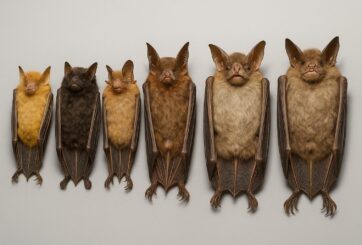
Just in time for Halloween, researchers from the Royal Ontario Museum (ROM), the Field Museum in Chicago, and Lawrence University in Wisconsin have announced the discovery of six new species of bats. These newly identified species, all found in the Philippines, belong to the group known as tube-nosed bats—a fascinating and diverse branch of the mammal family tree. Expanding the Tree of Life Formally recognized as new species through morphological and genetic analysis, this discovery expands the already impressive global…
In a recent study published today in the European Geosciences Union (EGU) journal Biogeosciences, scientists have confirmed that mercury pollution from artisanal and small-scale gold mining (ASGM) is contaminating food crops not through the soil, as previously believed, but directly from the air. Driven by the surging price of gold, which has increased by more than tenfold since 2000, the rapid expansion of unregulated mining in these regions raises urgent questions about food security, human health, and environmental justice The…
A new study from Iceland’s Surtsey island shows that birds carried most of the plants that colonised the island, challenging long-held beliefs that seed or fruit shape determines how plants spread — offering fresh insight into life’s adaptation to c When the volcanic island of Surtsey rose from the North Atlantic Ocean in 1963, it offered scientists a once-in-a-lifetime opportunity to observe how life takes hold on a brand-new and barren land. For decades, ecologists believed that plants’ ability to…
 Feedback
