



Feeding 9 Billion: Innovations in Agricultural Modeling
A recently awarded $716,000 grant from the U.S. Air Force Office of Scientific Research will fund research by Arizona State University professor Alex Mahalov aimed at reducing those anxious moments for air travelers.
Mahalov also will study another kind of atmospheric turbulence that poses problems for astronomers.
Optical turbulence results from the amplitude and phase fluctuations in electromagnetic waves propagating through the atmosphere, which is what causes stars to appear to “twinkle.” It also is a major source of telescope image degradation, making it difficult for astronomers to get clear views into space.
Mahalov is a professor in the Department of Mathematics and Statistics in ASU’s College of Liberal Arts and Science, with a joint appointment in the Department of Mechanical and Aerospace Engineering in the university’s Ira A. Fulton School of Engineering.
Working in the engineering school’s Center for Environmental Fluid Dynamics, Mahalov will use funding from the grant over a three-year period to improve techniques for identifying, forecasting and detecting areas of clear-air turbulence and modeling of optical turbulence under extreme environmental conditions.
He will collaborate with experts at the National Center for Atmospheric Research in Boulder, Colo., on improving the ability of numerical codes to forecast clear-air turbulence, particularly in areas of mountainous terrain.
“Improved real-time predictability and forecasting of high-impact, clear-air turbulence events will minimize the potential for costly devastation to human life and loss of business assets,” Mahalov says.
He also will work with astronomers at the observatories at Mauna Kea in Hawaii on using adaptive optics to reduce telescope image degradation caused by atmospheric optical turbulence.
Mahalov works with ASU’s high-performance computing group on creating real-time, high-resolution environmental forecasts. When researchers study multi-scale dynamics over a relatively limited geographic area, he explains, they need to use high-resolution models to produce accurate predictions.
Mahalov will use the facilities of the engineering school’s High Performance Computing Initiative to address complex research problems, from identifying the optical effects of the jet stream above astronomical observatories to understanding the effects of environmental transport on global and regional scales. Environmental transport involves the movement of chemical and particulate matter – such as ozone and other pollutants – as they are released into the atmosphere.
Mahalov has had almost 100 peer-reviewed research articles published. In 2004 he received a High Performance Computing Challenge grant from the Department of Defense High Performance Computing Modernization Program. The project funded by the grant was the subject of a featured presentation at the annual conference of the International Society for Optical Engineering in San Jose, Calif., in January 2008.
Mahalov often collaborates with top scholars in his field from around the world, including those with the European Center for Medium Range Weather Forecasting in Reading, England and the Laboratoire de Meteorologie Dynamique at the University of Paris.
SOURCE:
Alex Mahalov, alex.mahalov@asu.edu
Professor
Mathematics and Statistics
Mechanical and Aerospace Engineering
(480) 965-0408
Center for Environmental Fluid Dynamics
(480) 965-5602




Earthquakes in the American state of Utah, the Soultz-sous-Forêts region of France or in the Dutch province of Groningen should not be able to occur even if the subsurface has been exploited for decades. This is because the shallow subsurface behaves in such a way that faults there become stronger as soon as they start moving. At least that is what geology textbooks teach us. And so, in theory, it should not be possible for earthquakes to occur. So why…
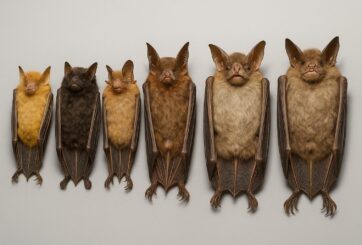
Just in time for Halloween, researchers from the Royal Ontario Museum (ROM), the Field Museum in Chicago, and Lawrence University in Wisconsin have announced the discovery of six new species of bats. These newly identified species, all found in the Philippines, belong to the group known as tube-nosed bats—a fascinating and diverse branch of the mammal family tree. Expanding the Tree of Life Formally recognized as new species through morphological and genetic analysis, this discovery expands the already impressive global…
In a recent study published today in the European Geosciences Union (EGU) journal Biogeosciences, scientists have confirmed that mercury pollution from artisanal and small-scale gold mining (ASGM) is contaminating food crops not through the soil, as previously believed, but directly from the air. Driven by the surging price of gold, which has increased by more than tenfold since 2000, the rapid expansion of unregulated mining in these regions raises urgent questions about food security, human health, and environmental justice The…
A new study from Iceland’s Surtsey island shows that birds carried most of the plants that colonised the island, challenging long-held beliefs that seed or fruit shape determines how plants spread — offering fresh insight into life’s adaptation to c When the volcanic island of Surtsey rose from the North Atlantic Ocean in 1963, it offered scientists a once-in-a-lifetime opportunity to observe how life takes hold on a brand-new and barren land. For decades, ecologists believed that plants’ ability to…
 Feedback
