New research could ‘sense’ car crashes more accurately

Dr Michael Kraft and his team at the University of Southampton’s School of Electronics & Computer Science (ECS) are working with a Belgian company, Melexis, to develop innovative control and interface systems to improve the performance of existing micromachined sensors.
In this three-year research project, Melexis, a growing Belgium-based company, which produces integrated semiconductor device systems for use in the automotive market, has supplied micromachined accelerometers (a device for measuring acceleration) so that the team can assess and improve its performance using their interface and control circuits
‘There is a huge, just recently emerging demand for higher performance inertial sensors for intelligent automotive systems and many others,’ commented Dr Kraft. ‘Six to eight airbags are standard already; they need to be deployed by accelerometers that accurately sense the impact of a crash.’
According to Dr Kraft existing commercial accelerometers may not meet these increasing performance specifications. His research programme will take the Melexis accelerometer and use advanced electronics and control engineering to make it better, more versatile and easier to integrate at a system level.
‘This research suggests a radically different approach to improve the performance of these sensors, namely to work on the electronic interface and control systems aspects of these sensors, rather than the microfabricated sensing elements themselves,’ said Dr Kraft.
The prime beneficiaries of this research will be companies supplying sensors for automotive safety systems. Other applications such as for GPS (Global Positioning System) back-up systems, virtual reality systems, inertial navigation and guidance, and seismology, also require sensors with very high specification characteristics.
‘Little research has been done in this field, yet there is huge potential to make a real impact,’ said Dr Kraft. ‘With this approach it should be possible to develop a very versatile interface chip that can be used with a range of micromachined sensors.’
Media Contact
All latest news from the category: Automotive Engineering
Automotive Engineering highlights issues related to automobile manufacturing – including vehicle parts and accessories – and the environmental impact and safety of automotive products, production facilities and manufacturing processes.
innovations-report offers stimulating reports and articles on a variety of topics ranging from automobile fuel cells, hybrid technologies, energy saving vehicles and carbon particle filters to engine and brake technologies, driving safety and assistance systems.


Newest articles

Superradiant atoms could push the boundaries of how precisely time can be measured
Superradiant atoms can help us measure time more precisely than ever. In a new study, researchers from the University of Copenhagen present a new method for measuring the time interval,…

Ion thermoelectric conversion devices for near room temperature
The electrode sheet of the thermoelectric device consists of ionic hydrogel, which is sandwiched between the electrodes to form, and the Prussian blue on the electrode undergoes a redox reaction…
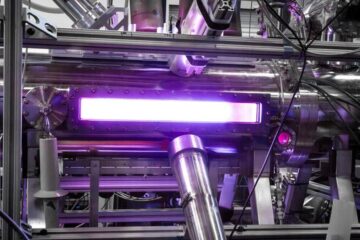
Zap Energy achieves 37-million-degree temperatures in a compact device
New publication reports record electron temperatures for a small-scale, sheared-flow-stabilized Z-pinch fusion device. In the nine decades since humans first produced fusion reactions, only a few fusion technologies have demonstrated…