



Feeding 9 Billion: Innovations in Agricultural Modeling
The University of Leeds’ NanoManufacturing Institute (NMI) will play a crucial role in the £9.5 million European Union-funded project by developing special walls for the house that contain nano polymer particles – these will turn into a liquid when squeezed under pressure, flow into the cracks, and then harden to form a solid material.
NMI chief executive Professor Terry Wilkins said: “What we’re trying to achieve here is very exciting; we’re looking to use polymers in much tougher situations than ever before on a larger scale.”
Nanotechnology involves making things with useful scientific properties on a tiny scale – less than one-hundred thousandth the width of a human hair.
The house walls will be built from novel load bearing steel frames and high-strength gypsum board. But they will be unique for another reason too – they’ll contain wireless, battery-less sensors and Leeds-designed radio frequency identity tags that collect vast amounts of data about the building over time, such as any stresses and vibrations, temperature, humidity and gas levels.
“If there are any problems, the intelligent sensor network will alert residents straightaway so they have time to escape,” added Professor Wilkins.
The Leeds team also includes Dr Roger Gregory, chairman of University spinout company Instrumentel Ltd, who said: “Leeds are world leaders in designing wireless networks for extreme environments and hard-to-access places. Even if the building totally collapsed, the sensors would still let you pinpoint the source of the fault.”
Instrumentel will work in partnership with Dr Greg Horler in the School of Electrical and Electronic Engineering to deliver this potentially life-saving technology.
Meanwhile, Professor Anne Neville’s team in the School of Mechanical Engineering will research new ways of designing the polymer nano-particles required.
Professor Wilkins said: “Once we have the optimum design, we could quickly start producing thousands of litres of nanoparticle fluid, adding just a tiny percentage to the gypsum mix.”
Leeds is the only UK university asked to join 25 other partners in the project, led by the German building manufacturer Knauf. Due to be completed in December 2010, the work is worth around £980,000 to Leeds.




On large, multi-storey construction sites, one of the biggest productivity hurdles is locating materials. Workers often lose valuable time searching for tools and supplies scattered across different floors. This inefficiency not only delays progress but also increases project costs. A new study, “IoT-Altimeter in Smart Pallets for Material Tracking on Multi-storey Construction Sites”, introduces a simple yet effective solution: equipping standard pallets with smart IoT devices that automatically track their location by floor level. How the System Works The upgraded…
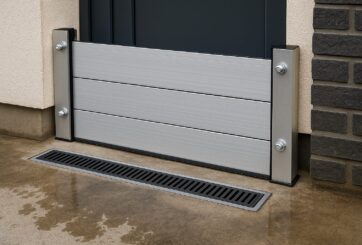
Introducing a severe impacts approach to guide adaptation to pluvial floods in residential and public buildings The risk of heavy rainfall and severe flooding increases with climate change. But property owners – regardless of size – often underestimate their own responsibility and are unaware of what preventive measures they can take themselves. In a new scientific article, researchers from Linköping University, Sweden, show how to go about preventive work. Many property owners believe that it is the municipality’s responsibility to…
A new seismic study of Singapore could guide urban growth and renewable energy development in the coastal city nation, where 5.6 million residents live within an area of 734 square kilometers. The study, published in Seismological Research Letters, identifies areas with increased risk of ground shaking and a possible reservoir for geothermal energy production, as well as a glimpse at Singapore’s tectonic history. Jiayuan Yao of China University for Geosciences and colleagues analyzed teleseismic data captured by a few permanent…
Design to withstand hurricanes isn’t enough to protect tall buildings and facade systems against the climate crisis Houston, we have a problem. The ‘Space City’ boasts 50 buildings over 150 meters tall. These were designed to withstand hurricanes, to which Texas is prone. But on May 16th, 2024, a derecho – a wide, long-lived windstorm associated with rapidly moving showers or thunderstorms – managed to cause unexpected damage to many of the tall buildings downtown. The socio-economic impact was significant, due…
 Feedback
