



Feeding 9 Billion: Innovations in Agricultural Modeling
Recently, it has been suggested a new formula, confirmed with numerical simulations, which is going to make the prediction of the seismic resistance of reinforced concrete structures easier, based on its capacity to take up and disperse energy.
The director of this work, which has been recently published in the international journal Engineering Structures, is Professor Amadeo Benavent Climent, of the Department of Continuous Means and Theory of Structures of the University of Granada [http://www.ugr.es]. They intend to predict “in case of earthquake, the maximum amount of seismic energy this kind of structures could take up and disperse without risk of collapse”, Benavent Climent explains.
The higher this energy is, the higher the building´s resistance capacity will be. Such energy depends fundamentally on ductility, this is, on the ability of the structure to become twisted without breaking. The new formula allows to assess the seismoresistance of the structures and, comparing it with the seismicity of the area where the construction is located, to draw conclusions about if reconditioning them is necessary or not, whether by means of conventional techniques or by advanced methods like that of energy dispersers. This technique consists of installing special elements in the structure that avoid that pillars and beams suffer important damage in case of earthquake. The next extension of the Architects´ Association of Granada will be the first Spanish building with these special energy dispersers.
One of the present goals for seismic engineering is to control damage (reducing or removing it) in structures subjected to earthquakes. According to current rules of most countries, like Spain, conventional buildings are deigned to, in case of earthquake, experience important plastic deformations but without collapsing, to avoid the loss of human lives. However, allowing such plastic deformations means to admit structurale damages, which can make the demolition of the building after the earthquake advisable.




On large, multi-storey construction sites, one of the biggest productivity hurdles is locating materials. Workers often lose valuable time searching for tools and supplies scattered across different floors. This inefficiency not only delays progress but also increases project costs. A new study, “IoT-Altimeter in Smart Pallets for Material Tracking on Multi-storey Construction Sites”, introduces a simple yet effective solution: equipping standard pallets with smart IoT devices that automatically track their location by floor level. How the System Works The upgraded…
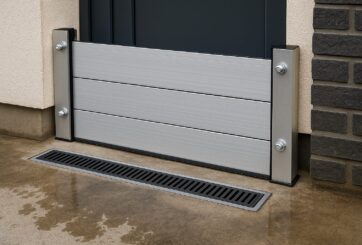
Introducing a severe impacts approach to guide adaptation to pluvial floods in residential and public buildings The risk of heavy rainfall and severe flooding increases with climate change. But property owners – regardless of size – often underestimate their own responsibility and are unaware of what preventive measures they can take themselves. In a new scientific article, researchers from Linköping University, Sweden, show how to go about preventive work. Many property owners believe that it is the municipality’s responsibility to…
A new seismic study of Singapore could guide urban growth and renewable energy development in the coastal city nation, where 5.6 million residents live within an area of 734 square kilometers. The study, published in Seismological Research Letters, identifies areas with increased risk of ground shaking and a possible reservoir for geothermal energy production, as well as a glimpse at Singapore’s tectonic history. Jiayuan Yao of China University for Geosciences and colleagues analyzed teleseismic data captured by a few permanent…
Design to withstand hurricanes isn’t enough to protect tall buildings and facade systems against the climate crisis Houston, we have a problem. The ‘Space City’ boasts 50 buildings over 150 meters tall. These were designed to withstand hurricanes, to which Texas is prone. But on May 16th, 2024, a derecho – a wide, long-lived windstorm associated with rapidly moving showers or thunderstorms – managed to cause unexpected damage to many of the tall buildings downtown. The socio-economic impact was significant, due…
 Feedback
