



Feeding 9 Billion: Innovations in Agricultural Modeling
Scientists at the Technische Universität Dresden/Germany have been developing an innovative composite material – “textile reinforced concrete“ – which is to serve for the structural reinforcement of buildings. For seven years now, more than 50 scientists from eight institutes have been collaborating in a research project entitled “Textile Reinforcements for Structural Strengthening and Repair“. The project has been funded by the German Research Foundation which has approved of the project’s third phase in June 2005, granting 1,5 million euros p.a.
The research team is made up of scientists from faculties of the Technische Universität Dresden as diverse as the Faculty of Civil Engineering, the Faculty of Mechanical Engineering and the Faculty of Forestry, Geosciences and Hydrosciences but also from the Institute of Polymer Research e.V. The focus of the scientists has mainly been on the structural reinforcement of buildings with the help of textile reinforced concrete. The benefits of the new composite material are obvious: Concrete bears up under great pressure. However, since this is not true for tensile loads, the concrete has to be reinforced, using steel. Yet because of the steel’s tendency to oxidise it has to be covered with a concrete layer sufficiently thick so the oxidisation is prevented. As a consequence of construction, the combination of both concrete and steel creates a particular thickness corresponding with a certain weight. Because of this, experts have been trying for many years to use alkali-resistant glass fibres instead of steel in order to produce slim, light-weight and non-corrosive structures.
Textile reinforced concrete has been jointly developed by Professor Peter Offermann of the Institute of Textile and Clothing Technology and Professor Curbach of the Institute of Concrete Structures as well as other scientists at the TU Dresden. It could be ideally used for the structural strengthening of old buildings presumably reinforced with steel. However, the new compound has generated a lot of questions, for instance it has to correspond with safety standards necessary in civil engineering. Thus, the research project divides into 16 sub-projects each of which deals with detailed individual questions. The project is characterised by interdisciplinary cooperation. Frequently, work results raise novel questions and the general development impacts upon the research, too: “We partly change from glass to carbon because the price of carbon is getting more and more favourable nearly every day“ says Professor Curbach. Carbon shows a great strength and offers additional benefits with regard to the longtime characteristics important for buildings.




On large, multi-storey construction sites, one of the biggest productivity hurdles is locating materials. Workers often lose valuable time searching for tools and supplies scattered across different floors. This inefficiency not only delays progress but also increases project costs. A new study, “IoT-Altimeter in Smart Pallets for Material Tracking on Multi-storey Construction Sites”, introduces a simple yet effective solution: equipping standard pallets with smart IoT devices that automatically track their location by floor level. How the System Works The upgraded…
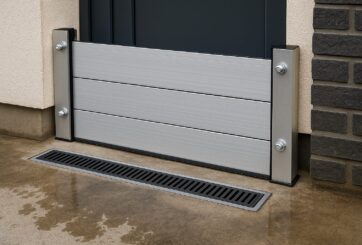
Introducing a severe impacts approach to guide adaptation to pluvial floods in residential and public buildings The risk of heavy rainfall and severe flooding increases with climate change. But property owners – regardless of size – often underestimate their own responsibility and are unaware of what preventive measures they can take themselves. In a new scientific article, researchers from Linköping University, Sweden, show how to go about preventive work. Many property owners believe that it is the municipality’s responsibility to…
A new seismic study of Singapore could guide urban growth and renewable energy development in the coastal city nation, where 5.6 million residents live within an area of 734 square kilometers. The study, published in Seismological Research Letters, identifies areas with increased risk of ground shaking and a possible reservoir for geothermal energy production, as well as a glimpse at Singapore’s tectonic history. Jiayuan Yao of China University for Geosciences and colleagues analyzed teleseismic data captured by a few permanent…
Design to withstand hurricanes isn’t enough to protect tall buildings and facade systems against the climate crisis Houston, we have a problem. The ‘Space City’ boasts 50 buildings over 150 meters tall. These were designed to withstand hurricanes, to which Texas is prone. But on May 16th, 2024, a derecho – a wide, long-lived windstorm associated with rapidly moving showers or thunderstorms – managed to cause unexpected damage to many of the tall buildings downtown. The socio-economic impact was significant, due…
 Feedback
