



Feeding 9 Billion: Innovations in Agricultural Modeling
Tension is mounting for three teams of architects and engineers who are competing for the design of the new British Antarctic Survey (BAS) Halley Research Station. The winning team will be announced on Tuesday 19 July.
The Jury Panel and technical advisory team have a difficult choice to select just one from three stunning solutions. Each proposal is designed to withstand Antarctica’s extreme environment. Each scheme is elevated above the ice to avoid burial by snow; and is capable of being relocated inland periodically as the ice shelf flows towards the sea. In addition to the huge engineering and technical challenges posed by building on a floating ice shelf, each team has demonstrated their creative and aesthetic expertise to design a stimulating living and working environment that is safe, comfortable and sensitive to BAS requirements for energy efficiency and protection of Antarctica’s pristine environment.
An exhibition of all three schemes will be on display at RIBA from 19 July-6 August. Preview images are available on www.antarctica.ac.uk
The three finalists are listed below in alphabetical order with the lead consultant for each team named first:
Buro Happold Ltd/Lifschutz Davidson Sandilands/Garrad Hassan & Partners Ltd/SLR Consulting Ltd/Human Engineering. This team has come up with three robust yet delicate fabric-covered craft that apparently ‘hover’ on legs above the ice. Glowing translucent skin encloses generously-proportioned interiors defined by specially-fabricated walls of integral furniture; these can be reconfigured to create a flexible, stimulating environment for scientific research and a welcoming, low-maintenance home that enhances the science and support team’s wellbeing.
Faber Maunsell and Hugh Broughton’s modular system, elevated on ski-based jackable legs, can be towed across the ice. The modules are simple to construct and can be re-arranged or relocated to suit the changing needs of the science programmes. The space age-looking station will be packed with stimulating areas for recreation and relaxation. It features renewable energy sources and new environmentally contained strategies for fuel, waste and material handling.
Hopkins Architects/Expedition Engineering/Atelier Ten/Davis & Langdon have designed two aerodynamic, elevated ‘walking’ buildings that minimise effort of raising, snow-management and relocation. External walls, surrounded with a ‘puffer jacket’ of structural fabric pillows, streamline the building and provide additional insulation. The team believe the quality of architecture is crucial to the wellbeing, morale and productivity of science and support staff living and working at Halley.




On large, multi-storey construction sites, one of the biggest productivity hurdles is locating materials. Workers often lose valuable time searching for tools and supplies scattered across different floors. This inefficiency not only delays progress but also increases project costs. A new study, “IoT-Altimeter in Smart Pallets for Material Tracking on Multi-storey Construction Sites”, introduces a simple yet effective solution: equipping standard pallets with smart IoT devices that automatically track their location by floor level. How the System Works The upgraded…
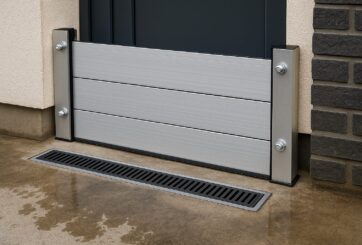
Introducing a severe impacts approach to guide adaptation to pluvial floods in residential and public buildings The risk of heavy rainfall and severe flooding increases with climate change. But property owners – regardless of size – often underestimate their own responsibility and are unaware of what preventive measures they can take themselves. In a new scientific article, researchers from Linköping University, Sweden, show how to go about preventive work. Many property owners believe that it is the municipality’s responsibility to…
A new seismic study of Singapore could guide urban growth and renewable energy development in the coastal city nation, where 5.6 million residents live within an area of 734 square kilometers. The study, published in Seismological Research Letters, identifies areas with increased risk of ground shaking and a possible reservoir for geothermal energy production, as well as a glimpse at Singapore’s tectonic history. Jiayuan Yao of China University for Geosciences and colleagues analyzed teleseismic data captured by a few permanent…
Design to withstand hurricanes isn’t enough to protect tall buildings and facade systems against the climate crisis Houston, we have a problem. The ‘Space City’ boasts 50 buildings over 150 meters tall. These were designed to withstand hurricanes, to which Texas is prone. But on May 16th, 2024, a derecho – a wide, long-lived windstorm associated with rapidly moving showers or thunderstorms – managed to cause unexpected damage to many of the tall buildings downtown. The socio-economic impact was significant, due…
 Feedback
