



Feeding 9 Billion: Innovations in Agricultural Modeling
An automatic sprinkler system significantly increases a person’s chances of surviving a dormitory fire, according to a report issued recently by the National Institute of Standards and Technology (NIST).
Three NIST experiments,* supported by a U.S. Fire Administration (USFA) initiative for fire safety in college housing, compared the hazards of fires in smoke detector-equipped dormitories with and without fire sprinklers in the room of fire origin. Researchers started fires in a day room or lounge area open to the corridor of a dormitory. They used the temperature of 120 degrees C (248 degrees F) as the cutoff mark for human survival. For comparison, the temperature of boiling water is 100 degrees C.
In two experiments without sprinklers, potentially fatal temperatures exceeding 120 degrees C as well as toxic gases reached a remote corridor 22.9 meters (75 feet) away within three minutes and completely spread throughout the corridor within another three minutes. In an experiment with sprinklers, temperatures at the 1.5 meter (five feet) level and below in the room where the fire began never exceeded 120 degrees C. No significant increase in heat was measured in the corridor during the experiment, allowing adequate time for residents to escape.
NIST conducted the experiments at a barracks donated by the Myrtle Beach Air Force Base Redevelopment Authority in Myrtle Beach, S.C. The USFA incorporated footage of NIST sprinkler tests into a fire safety video for college administrators and students.




On large, multi-storey construction sites, one of the biggest productivity hurdles is locating materials. Workers often lose valuable time searching for tools and supplies scattered across different floors. This inefficiency not only delays progress but also increases project costs. A new study, “IoT-Altimeter in Smart Pallets for Material Tracking on Multi-storey Construction Sites”, introduces a simple yet effective solution: equipping standard pallets with smart IoT devices that automatically track their location by floor level. How the System Works The upgraded…
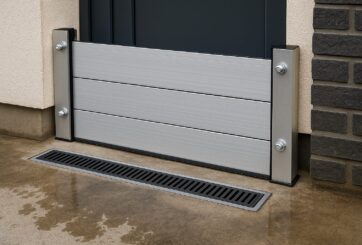
Introducing a severe impacts approach to guide adaptation to pluvial floods in residential and public buildings The risk of heavy rainfall and severe flooding increases with climate change. But property owners – regardless of size – often underestimate their own responsibility and are unaware of what preventive measures they can take themselves. In a new scientific article, researchers from Linköping University, Sweden, show how to go about preventive work. Many property owners believe that it is the municipality’s responsibility to…
A new seismic study of Singapore could guide urban growth and renewable energy development in the coastal city nation, where 5.6 million residents live within an area of 734 square kilometers. The study, published in Seismological Research Letters, identifies areas with increased risk of ground shaking and a possible reservoir for geothermal energy production, as well as a glimpse at Singapore’s tectonic history. Jiayuan Yao of China University for Geosciences and colleagues analyzed teleseismic data captured by a few permanent…
Design to withstand hurricanes isn’t enough to protect tall buildings and facade systems against the climate crisis Houston, we have a problem. The ‘Space City’ boasts 50 buildings over 150 meters tall. These were designed to withstand hurricanes, to which Texas is prone. But on May 16th, 2024, a derecho – a wide, long-lived windstorm associated with rapidly moving showers or thunderstorms – managed to cause unexpected damage to many of the tall buildings downtown. The socio-economic impact was significant, due…
 Feedback
